

As a strategic Northern Beaches Buyers Agent and Upper North Shore and Lower North Shore Buyers Agent, we know first-hand that buying residential property across the Northern Beaches or North Shore is not a weekend errand. It is a multi-million-dollar capital allocation decision that will shape your family’s balance sheet for decades.
The question is not who can locate a listing fastest.
The question is: who is structurally built to protect your capital?
In residential real estate, two operating models now exist:
- The high-volume “factory” buyers agency
- The director-led strategic advisory
They look similar from the outside. They are not.
The Factory Model of Buying Property
In almost every industry, there is a point where professionalism quietly turns into production.
The rise of the factory buyers agency model has made it possible for firms to advertise:
- 5,000 properties purchased
- $10 billion in transactions
- Hundreds of five-star reviews
The implicit message is simple:
“We do a lot, therefore we must be good.”
Behind the scenes, the economics are equally straightforward:
- Large teams of junior or mid-level buyers agents
- Percentage-based fee structures that increase with purchase price
- A focus on speed and throughput
The name on the website wins the engagement.
The file is often handed down.
The client believes they hired a trusted adviser.
In reality, they entered a pipeline.

The Leverage Model — And Why It Matters
Earlier in my career as a Partner at Accenture in London, I worked within what consulting firms refer to as a leverage model.
The Partner secures the engagement.
Strategy is defined at senior level.
Execution is delivered by a leveraged team.
This structure is not inherently flawed. It is commercially efficient and widely used across global advisory firms.
But it creates a structural trade-off:
- More clients
- Greater throughput
- Higher revenue
Or:
- Fewer engagements
- Higher senior attention
- Greater judgement density
In some sectors, leverage works well.
In high-stakes capital allocation decisions, it requires extreme discipline.
Residential property has quietly adopted its own version of this leverage model.
The principal wins the brief.
The work is delegated.
Oversight varies.
That is not a criticism. It is an economic reality.
The question is simply:
What matters more to the client — quantity or quality?
Why Volume and Junior Delegation Is Risky in Property
There is nothing wrong with junior professionals.
The issue is what they are entrusted to do — and what is at stake.
In many factory-style buyers agencies:
- A senior rainmaker secures the mandate.
- Search, inspection and negotiation are delegated.
- KPIs measure activity and conversions.
- Percentage fees increase as purchase price increases.
For routine transactions, that may be sufficient.
For a multi-million-dollar acquisition anchoring long-term family wealth, the risk profile is different.
You would not ask a junior associate to structure a corporate acquisition or oversee your retirement portfolio.
Yet in residential property, this is often what occurs.

How a Strategic Buyers Agency Operates Instead
We built Sarah Kaye & Co. around the opposite philosophy:
Fewer clients. Deeper work. Senior judgement only.
Three principles define how a strategic buyers agency operates.
1. Director-Led — Always
Every search.
Every negotiation.
Every judgement call.
Led by the same founding principals you meet at the first conversation.
There is no hand-off once the agreement is signed.
Continuity of judgement is not a marketing line — it is structural.
2. Fixed Fees. No Percentage Commissions.
If a property is secured for $3.2 million instead of $3.0 million under a percentage model, the adviser earns more.
Under our fixed-fee structure, whether we secure your home for $3 million or $2.8 million, our commercial outcome is identical.
That removes structural tension between adviser incentives and price discipline.
If we advise you to walk away, our income does not suffer.
That alignment is deliberate.
3. Limited Capacity — By Design
We cap the number of active engagements we accept.
We do not measure success by transaction count.
We measure it by:
- Quality of asset selection
- Risk mitigation
- Capital resilience across cycles
Institutional-grade thinking cannot be rushed.
Data Is Directional — Not Absolute
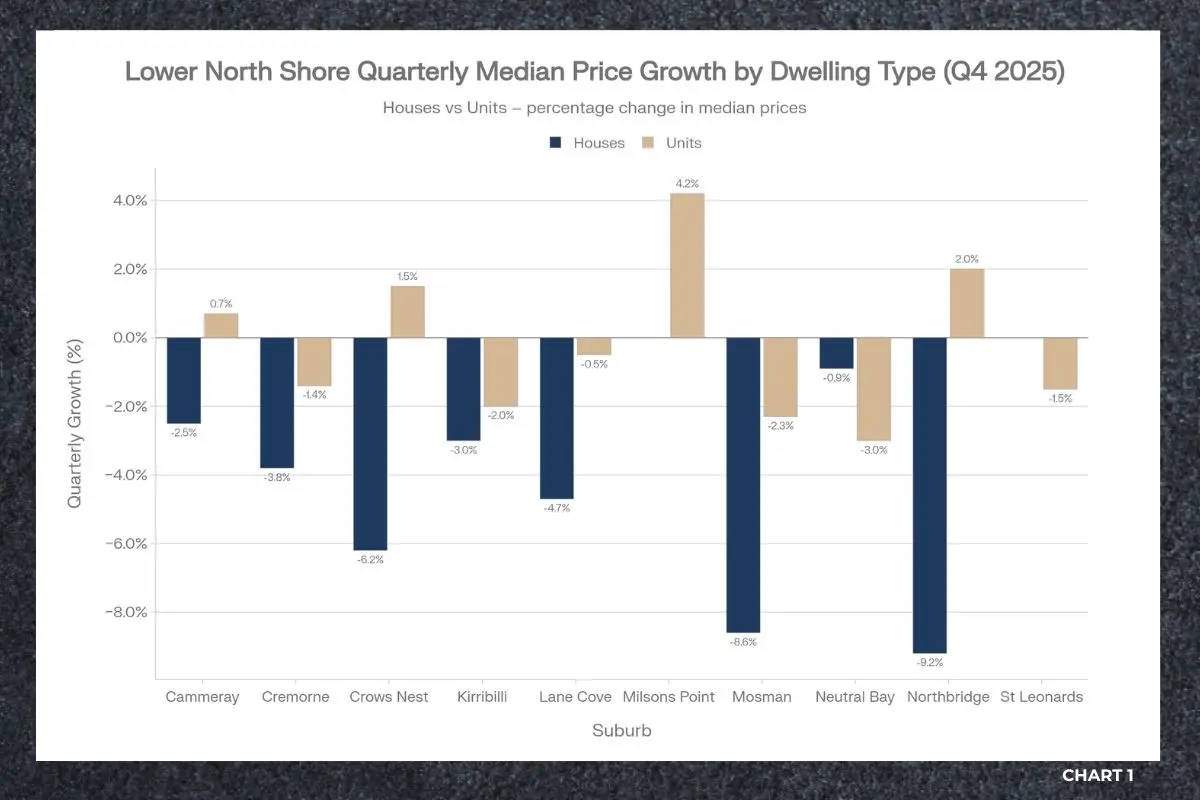
Most property commentary begins and ends with suburb medians.
In prestige markets, those numbers can be misleading.
In Palm Beach, reported house medians have simultaneously appeared at:
- $6,000,000 (rolling 12-month median)
- $4,458,643 (recent median value)
- $4.46M (recent median display)
In thin prestige markets, a small number of outlier transactions materially distort medians.
A strategic buyers agency does not treat reported data as the absolute truth.
We treat it as a directional signal — interrogated, reconciled and interpreted before valuation conclusions are formed.
Judgement governs data — not the reverse.
Buyers Agencies Should Be Professional Advisory Firms
At its best, a buyers agency is not a transactional business.
It is – or should be – a professional services firm.
The required core competencies are:
- Problem definition
- Capital allocation discipline
- Stakeholder alignment
- Risk identification
- Data interrogation
- Structured negotiation
Sales agents possess a different expertise: marketing assets and creating competitive tension.
That is not a criticism. It is a different professional discipline.
When buyers’ agencies adopt sales-driven KPIs and percentage-based structures, they can become purely transactional at best and, at worst, resemble the sell-side.
However, when buyers agencies adopt strong governance, fixed fees and director-led execution, they resemble advisory firms.
After all, structure determines behaviour.
Who the Factory Model Suits — And Who It Doesn’t
The factory model is not wrong for everyone.
It may suit you if:
- You are highly price-sensitive
- You primarily need auction representation
- Speed is your dominant priority
- You are comfortable within a high-volume system
However, a strategic buyers agency is designed for clients who:
- View their purchase as a capital allocation decision
- Expect boardroom-level scrutiny
- Want clarity on who is making judgment calls
If what you are buying is trusted, senior, independent advice, structure matters.

Why We Refuse to Run a Factory
The easiest way to grow a buyers agency is:
- Hire junior staff
- Push volume
- Charge percentage fees
The harder path is:
- Keep the firm focused and lean
- Keep the judgment senior
- Turn away work when necessary
We chose the harder path deliberately.
We did not leave senior corporate and real estate roles to build another sales machine.
We built Sarah Kaye & Co. to bring:
- Institutional rigour
- Fixed-fee alignment
- Director-level advocacy
To a market that too often confuses activity with judgment.
When you engage us, you are not entering a system.
You are sitting across the table from the adults in the room.
And we intend to keep it that way.

Author: Mike Kaye
Founding Principal | Strategic Property Advisory & Buyers Agency
Mike Kaye is Founding Principal of Sarah Kaye & Co., a director-led Strategic Property Advisory serving Sydney’s Northern Beaches, Upper North Shore and Lower North Shore. With a background as an ex-Accenture Global Partner and formal qualifications in property law, valuation and governance, he advises clients on disciplined property acquisition, risk management and long-term capital protection.