
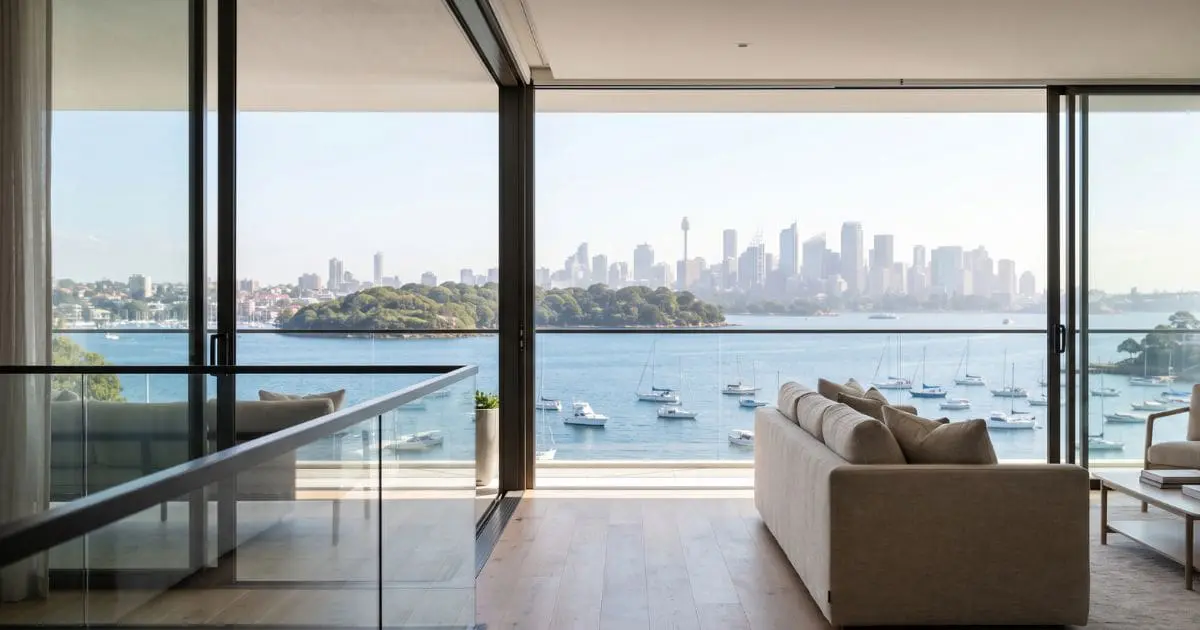
Two pieces of analysis, one honest picture — the macro view across the Lower North Shore, and the micro view inside Mosman.
Ask most people what has happened to prices at the top of the Lower North Shore and you tend to get the same answer: everything has doubled, the trophy homes are flying, and you would have been mad not to buy a decade ago. The first part is broadly true on paper. The rest deserves a closer look.
We have recently approached that question from two directions. We ran a deep dive into every Mosman house sale since 2015, and a wide sweep of every sale of $10 million or more right across the Lower North Shore — from Mosman in the east through to Hunters Hill in the west. Read together, the macro and the micro tell a more useful story than the headline number, and a more honest one. For anyone weighing up a purchase at the top of this market, the difference matters.
The $10 million club has grown up
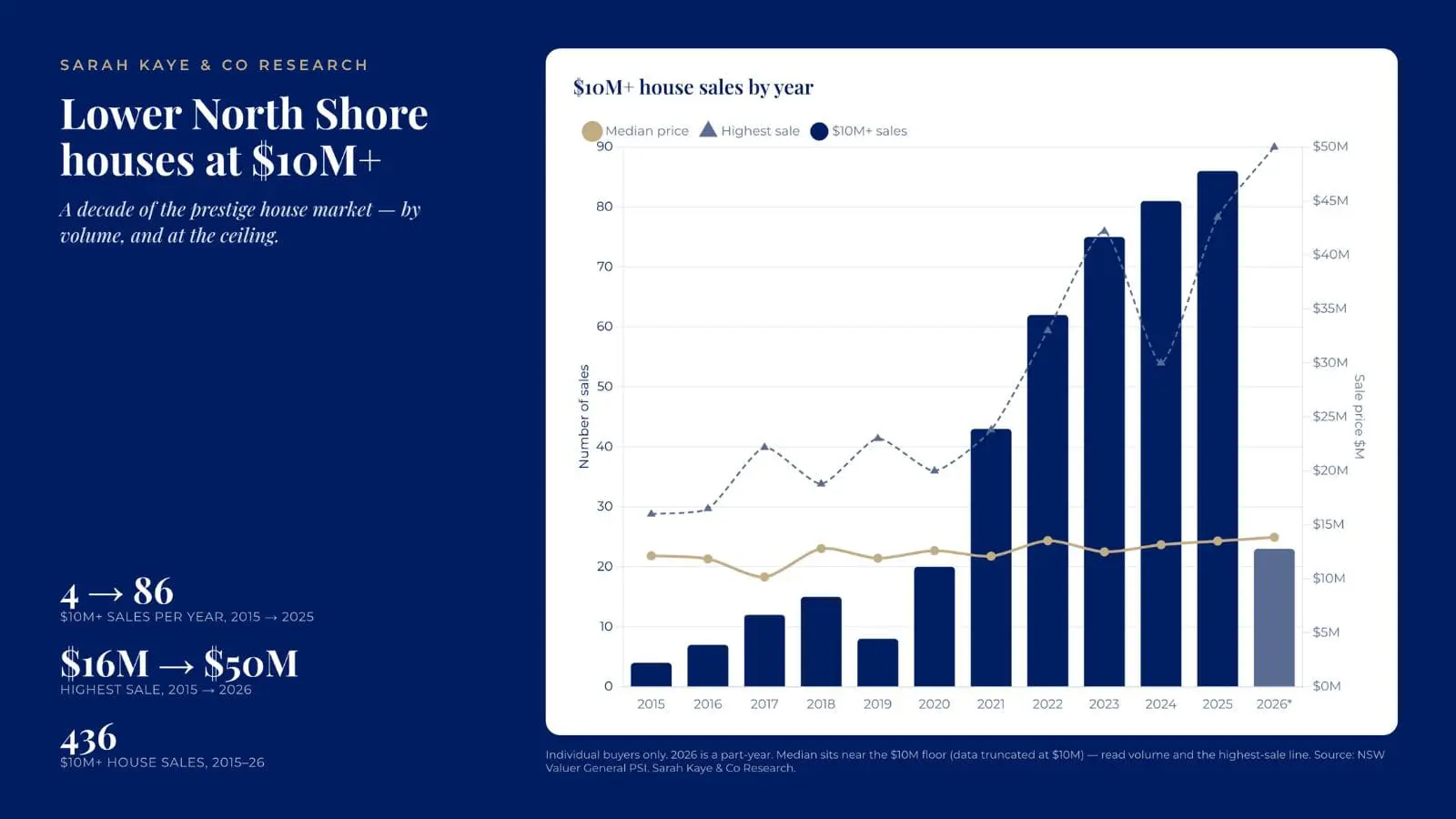
Start with the breadth of the market. Across the Lower North Shore we identified more than 470 genuine individual purchases of $10 million or more since 2015 (we removed development-site amalgamations, bulk strata settlements and corporate acquisitions from the raw data, so what remains is people buying homes). The pattern is unmistakable. In 2015 there were just four house sales at $10 million-plus across the entire region. By 2025 there were 86 — a rise of more than twentyfold. The number of homes trading above $10 million has gone from a rarity to a near-weekly event.
That broadening is the single biggest shift in the prestige market, and it is the one most commentary misses by fixating on a median. But it needs one honest qualification. A $10 million line is a fixed nominal threshold, and inflation quietly pushes more homes across it every year. Some of the club’s growth is genuine new prestige activity; some is simply the dollar buying less than it used to. Hold that thought, because it is the key to reading the rest.
Most of the headline growth is inflation
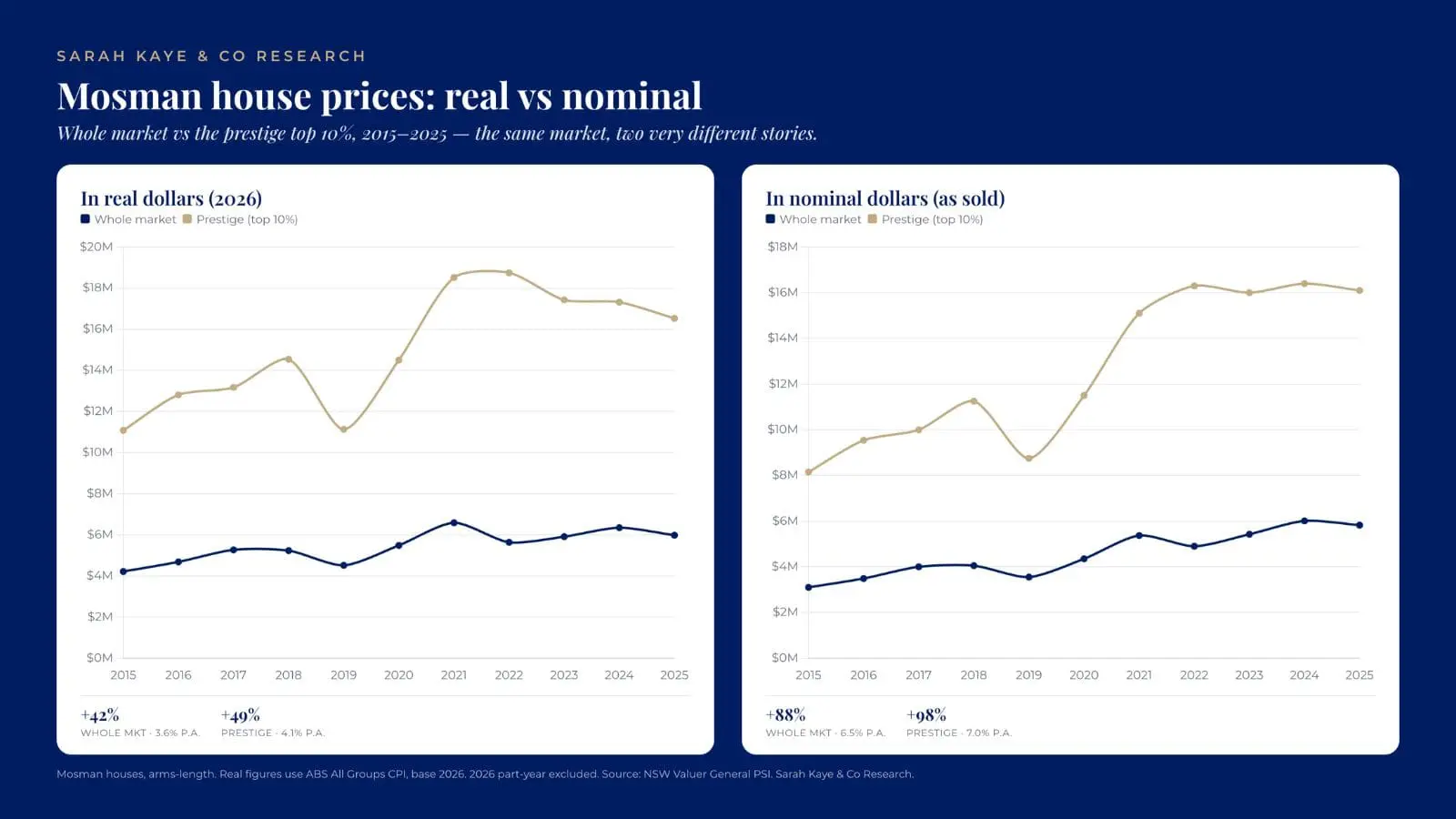
This is where the Mosman deep dive earns its keep, because Mosman has the depth of sales to measure properly. In plain, as-sold terms, the Mosman house median rose from $3.10 million in 2015 to $5.82 million in 2025 — up 88 per cent, which is where the “prices have doubled” story comes from. But once you convert every sale into today’s dollars using the Consumer Price Index, the broad market grew about 42 per cent over the decade, or 3.6 per cent a year in real terms. Solid, dependable growth — and a long way short of doubling.
The gap between those two numbers is the most important thing a prestige buyer can understand. Nearly half of the headline gain is not the house becoming more valuable; it is the currency becoming less so. A home that looks like it almost doubled has, in real purchasing power, grown by a bit over forty per cent. That is still a good result for an asset you also get to live in. It is just not the runaway number the dinner-party version implies.
Mosman is the centre of gravity
If you are buying a house in Mosman specifically, the regional picture sharpens. Of every cleaned $10 million-plus sale across the Lower North Shore, Mosman accounts for around 54 per cent — more than the rest of the region combined. Cremorne, Hunters Hill, Northbridge, Longueville and Kurraba Point follow, but none comes close. When people talk about the Lower North Shore prestige market, they are, more often than not, talking about Mosman.
That concentration is why we could measure Mosman so confidently. With 2,770 arms-length house sales since 2015, the suburb has enough depth for year-on-year medians to mean something — depth that thinner suburbs, where a single transaction can swing a yearly figure, simply do not have. So the Mosman numbers are not just relevant to a Mosman buyer; they are the most reliable read available on how the top of this market actually behaves.
What the prestige tier actually did
Within Mosman we isolated the prestige tier — the most expensive ten per cent of houses sold each year — and measured it the same disciplined way. In real terms it grew about 49 per cent over the decade, or 4.1 per cent a year, slightly ahead of the broad market. In nominal terms it looks like a near-doubling again, up 98 per cent. The prestige median now sits around 2.8 times the whole-of-market median, a premium that has held remarkably steady through the cycle.
But the more revealing signal is the ceiling, not the median. The highest Mosman-area house sale in our cleaned set climbed from $16 million in 2015 to $43.5 million in 2025, and the region’s top genuine sale now stands at $50 million, for 3 Kirkoswald Avenue, Mosman. The growth at the top end is showing up less in the typical price and more in two places: how often these homes trade, and how high the very best of them now reach. For a buyer, that is the difference between a market that is inflating evenly and one that is stretching at the summit.
Three houses that sold twice
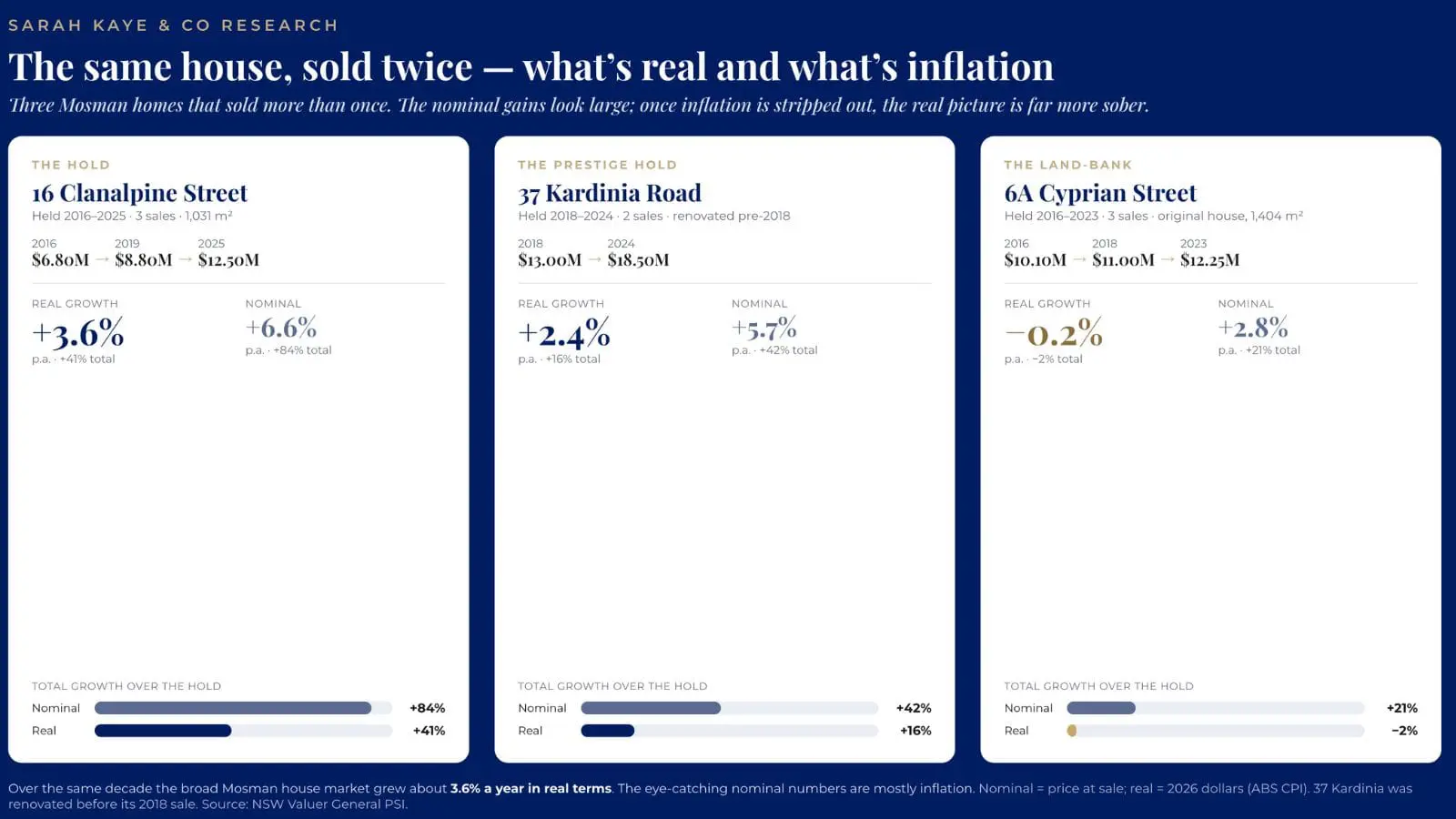
Medians describe a market, but they blend different houses together each year. The cleanest test of growth is a single property that sold, then sold again, largely unchanged — a true like-for-like. We found 485 Mosman houses that traded at least twice since 2015. Three of them tell the story better than any average, and together they show that “prestige” does not mean one thing.
16 Clanalpine Street — the hold
A 1920-built house on just over a thousand square metres, sold three times: $6.80 million in 2016, $8.80 million in 2019, and $12.50 million in 2025. In real terms that is 3.6 per cent a year — almost exactly the broad-market trend. A good house, held through the cycle, did what the market did. No more, no less.
37 Kardinia Road — the prestige hold
An inter-war bungalow, carefully renovated — its alterations won a 2017 local design award. Because that work was finished before it sold for $13 million in early 2018, the move to $18.50 million in 2024 is a clean like-for-like on an already-finished home: 2.4 per cent a year in real terms. Firmly in the prestige bracket, yet its real return was modest.
6A Cyprian Street — the land-bank
An original four-bedroom home on a generous 1,404 square metres. It sold for $10.10 million in 2016, $11 million in 2018 and $12.25 million in 2023. In nominal terms that reads as steady gains. In real terms it went slightly backwards — about minus 0.2 per cent a year. The value here is in the land, waiting; the house is almost incidental, and inflation quietly absorbed the paper gain.
There is a pattern worth naming behind those three. When we looked for prestige homes that sold twice and jumped sharply, almost every one had been renovated or rebuilt between sales. Those are real gains for the owner, but they are capital being spent to create value, not the market lifting a fixed asset. Strip out inflation and renovation, and the honest like-for-like return on an unimproved prestige hold is low single digits — and occasionally nothing at all. That is not a weakness of the market. It is the difference between a number that sounds impressive and one you can rely on when you are the buyer signing the cheque.
Mosman, street by street
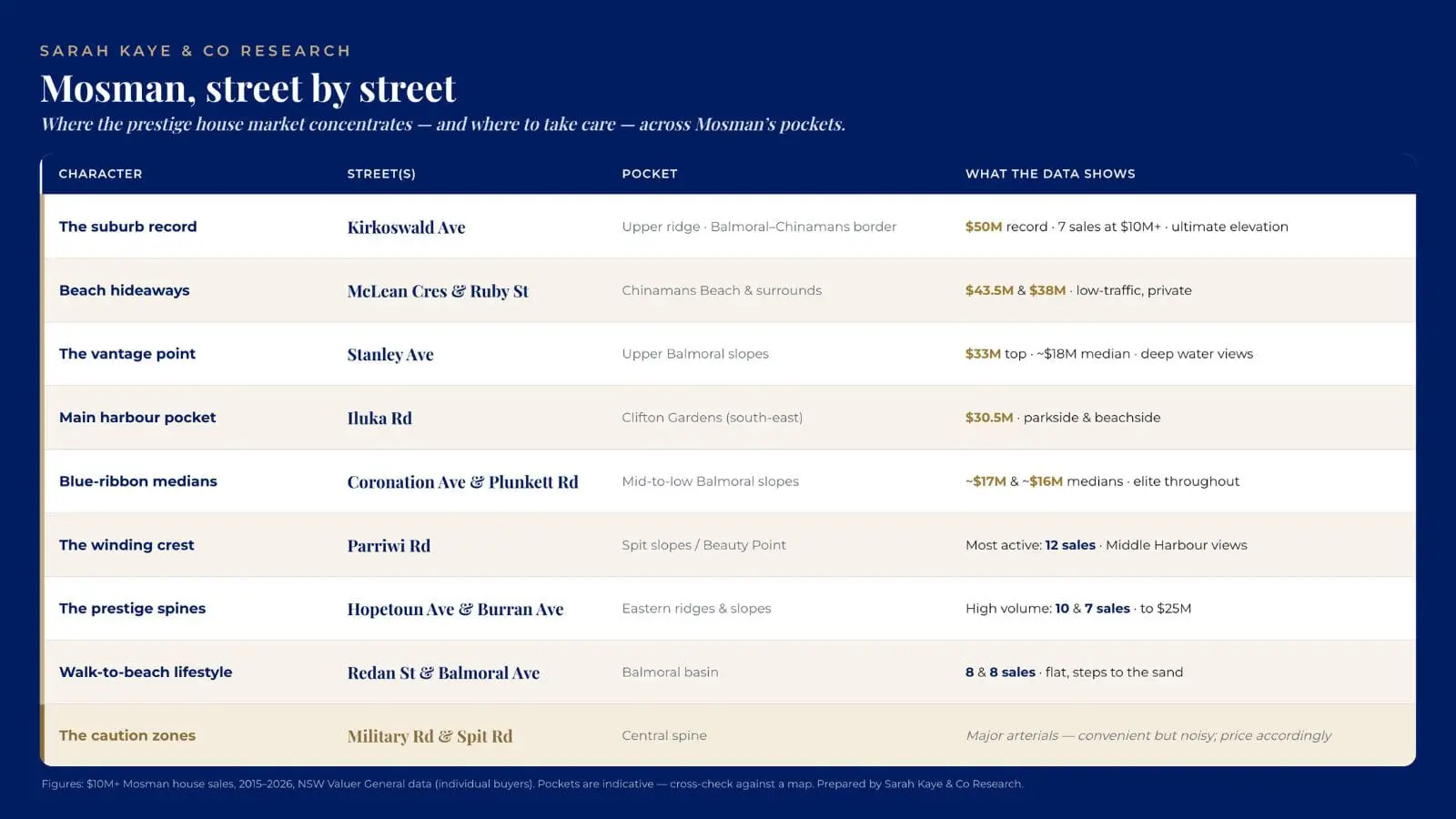
Zoom in one more level and Mosman is not a single market but a set of pockets, and the data shows exactly where the prestige money lands. Across our cleaned $10 million-plus sales, the most active streets are Parriwi Road, Hopetoun Avenue, Redan Street, Balmoral Avenue and Burran Avenue — the spine of the Balmoral slopes and the walk-to-village pockets, where buyers compete year after year.
If you are prepared to pay at the very top, the records cluster on the harbourfront and view streets. Kirkoswald Avenue holds the $50 million benchmark, with McLean Crescent ($43.5M), Ruby Street ($38M), Stanley Avenue ($33M) and Iluka Road in Clifton Gardens ($30.5M) close behind. A couple of streets carry the highest typical prices, not just one-off records — on Coronation Avenue and Plunkett Road even the median $10 million-plus sale sits above $16 million, which tells you the whole street is blue-ribbon, not just a single trophy on it.
For long-term growth rather than instant prestige, the durable performers tend to be the lifestyle-anchored streets: a flat, walkable distance to Balmoral Beach or Mosman village, a north-to-east aspect, and a quiet road. Demand for those rarely softens, because the thing driving it — proximity and light — cannot be manufactured or added later.
And there are streets we approach with more caution for a buyer focused on resale. Frontage or close proximity to the Military Road and Spit Road arterials brings traffic and noise that a premium buyer will eventually discount; steep, south-facing blocks with no district outlook work harder to hold their value; and the busier through-roads quietly trade a little capital growth for convenience. None of these are no-go zones — at the right price they can be excellent buying — but they are exactly where the gap between paying well and paying poorly is widest, and where independent eyes earn their keep.
Houses, not units — at least for now
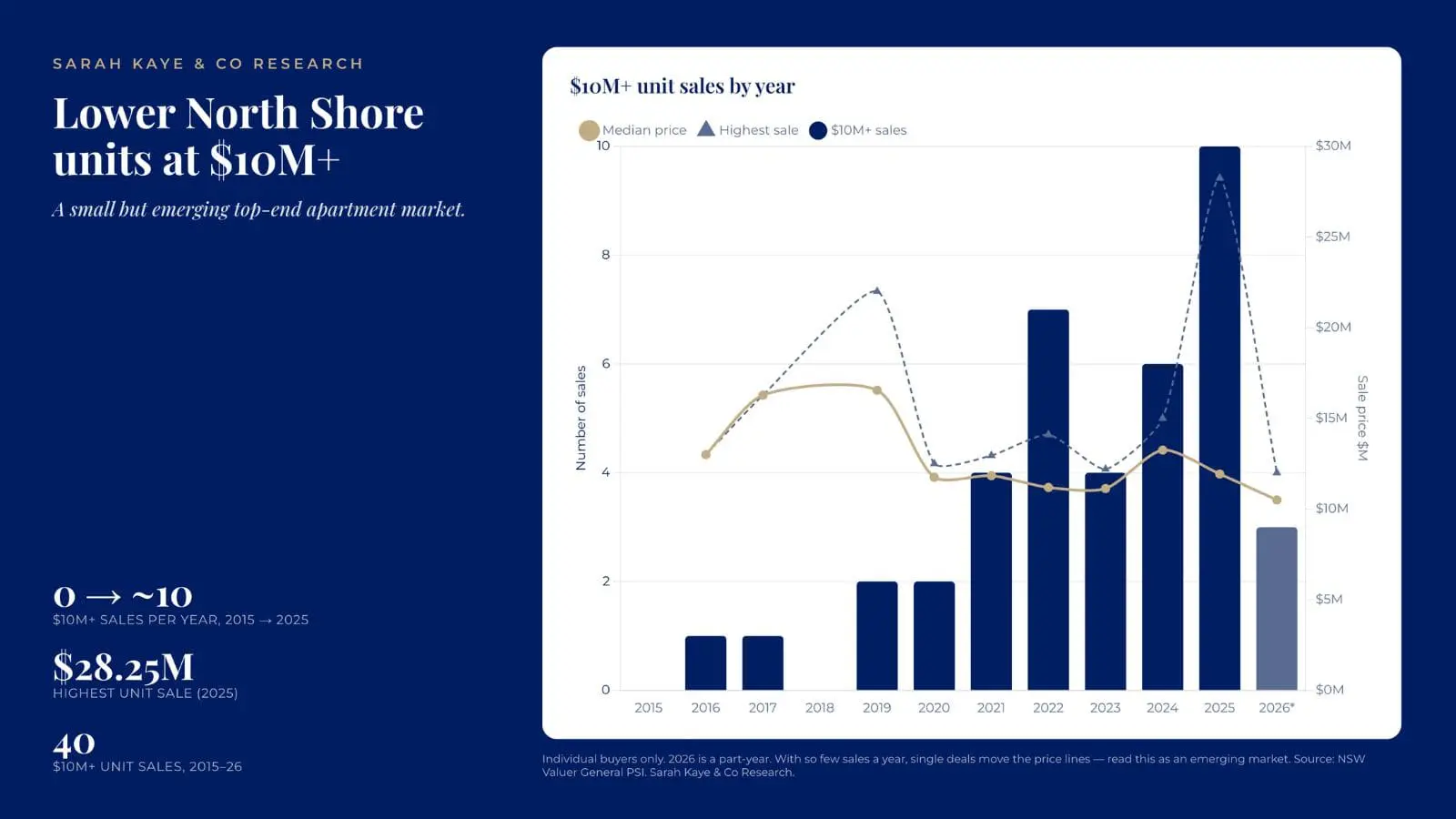
It is worth saying clearly: at this level, the Lower North Shore is a house market. Of the cleaned $10 million-plus sales, houses outnumber apartments by roughly eleven to one. The top-end unit market is real but small and only recently emerging — from no $10 million apartment sales in 2015 to around ten in 2025, with the standout being a $28.25 million apartment in 2025. For a buyer who wants a home rather than a view from the fortieth floor, the competition and the depth are overwhelmingly in houses, and that is unlikely to change quickly.
What it means if you are buying above $10 million
Put the two views together and a clear conclusion falls out. The Lower North Shore has been a sound place to own a prestige home, but the version of the story that says values double every decade is, in real terms, an illusion of inflation. Genuine growth on an unimproved home has run in the low single digits a year. The real work — the part that separates a good purchase from an expensive mistake — is done by two things the headline rate cannot see: buying the right asset, and buying it well.
When the underlying market only grows a few per cent a year in real terms, the price you negotiate on the day is not a rounding error; it is most of your return. That is sharper still in a segment this thin, where a handful of buyers chase a handful of homes and more than three-quarters of our own clients’ purchases are secured off-market, before they ever reach a public campaign. The edge in prestige property is not timing the market. It is knowing, street by street, what a home is genuinely worth, when the value sits in the dirt rather than the dwelling, and when to exercise the discipline to say no. That is the work we do for buyers, and only ever for buyers.
If you are weighing a purchase at the top of the Lower North Shore, the data above is the same evidence we bring to the table on day one. We are always happy to talk it through.
Methodology and sources
This article draws on two datasets, both sourced from NSW Valuer General Property Sales Information. (1) Mosman deep dive: all Mosman house sales, arms-length, $100,000 and above, contract dates 2015 to May 2026 (n = 2,770). Real-dollar figures use the ABS Consumer Price Index, All Groups, Australia, expressed in 2026 dollars; the prestige tier is the top 10 per cent of houses by price within each year. (2) Lower North Shore $10 million club: all sales of $10 million or more across the Mosman, North Sydney, Lane Cove, Hunters Hill and Willoughby council areas, cleaned to individual residential buyers by removing bulk and portfolio events, development-site amalgamations and corporate acquisitions (n = 477; about 436 houses and 40 units).
Read with care: in the $10 million-plus band the median is pinned near the threshold, so the trustworthy signals are sales volume and the highest-sale line, not the median. The 2026 year is a part-year; Valuer General data also lags settlement, so the most recent figures will firm up over time. Prepared by Sarah Kaye & Co Research, the firm’s director-led in-house analytics practice, in partnership with Anthropic’s Claude. Provided as market commentary, not as valuation or financial advice.
About the author
Mike Kaye is Co-Founder and Director of Sarah Kaye & Co., a boutique, director-led buyers agency working across Sydney’s Northern Suburbs — the Northern Beaches, the Lower North Shore and the Upper North Shore. He leads Sarah Kaye & Co Research, the firm’s in-house analytics practice. A former Accenture Global Partner and Australian Army Major, Mike studied property law, valuation and economics at UNSW and is a Graduate of the Australian Institute of Company Directors. His articles have been profiled and quoted in the Australian Financial Review, the Sydney Morning Herald and AICD Magazine. As a Lower North Shore buyers agent, Mike works exclusively for buyers — fixed-fee, no kickbacks, with over 75% of clients’ homes secured off-market.