

Sarah Kaye & Co Research
Nearly half the houses for sale north of the harbour have five or more bedrooms, and they are selling slowest in all three regions. Smaller homes are a different market.
Large houses are the slowest stock north of the harbour. Smaller houses are turning over more than twice as fast. That holds in all three of our regions, and it changes how you should buy in each.
On 18 November we counted the houses for sale on the Northern Beaches and North Shore, along with every unit and townhouse. We used realestate.com.au and the 95 suburbs we cover across the Northern Beaches, the Lower North Shore and the Upper North Shore. There were 2,858 homes listed. We also counted what sold in the last month: 732.
Put the two together and you get a simple measure. Sales in the last month equal 26% of what is listed today. The higher that figure, the faster a part of the market is turning over. It is a rough measure, and we explain its limits at the end. But it splits this market cleanly by size.
This is our first count, and we will repeat it every week. So we cannot yet say what is rising or falling. What we can say is where the stock is sitting today.
Nearly half the houses for sale have five or more bedrooms
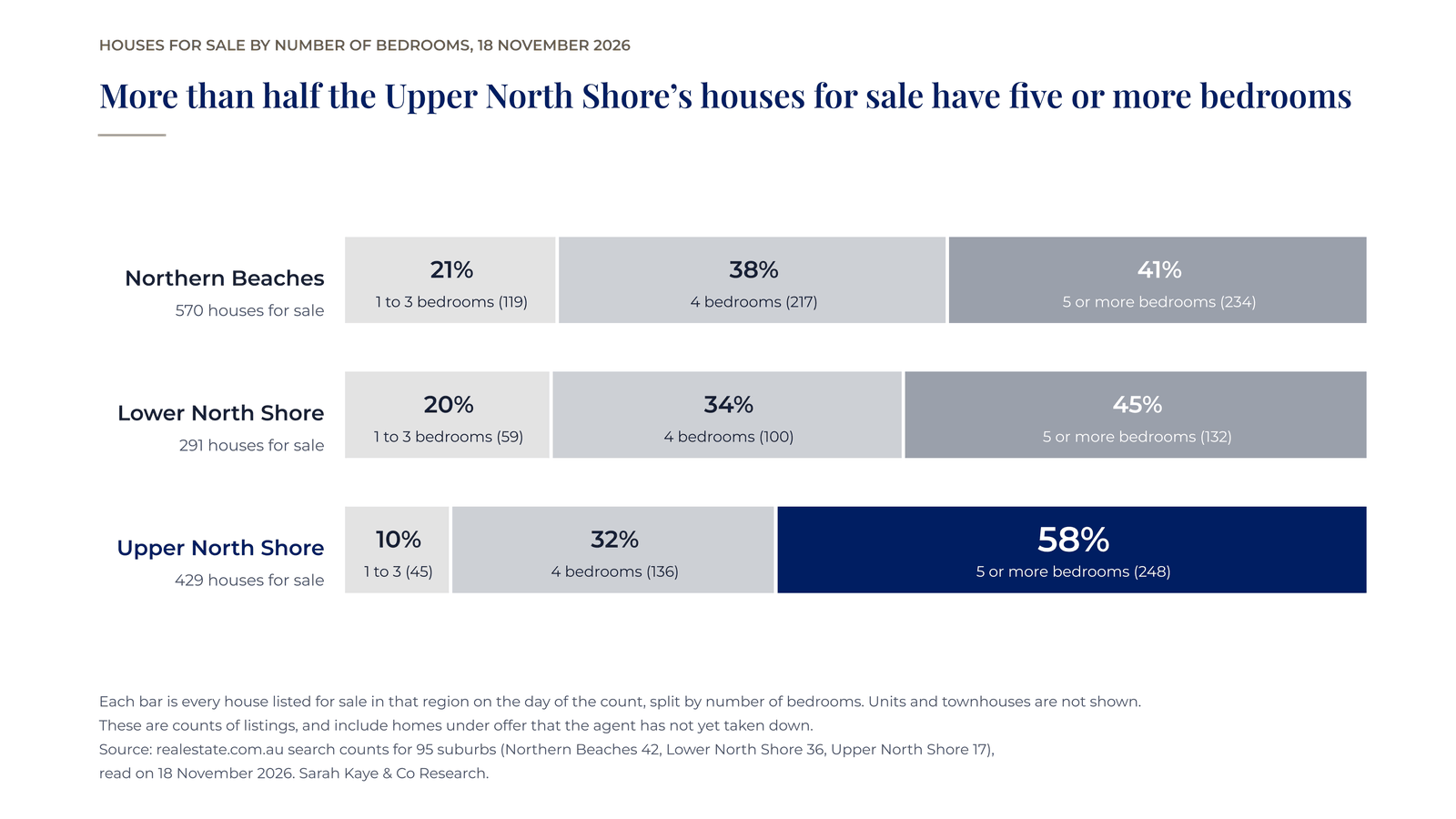
There are 1,290 houses for sale north of the harbour, and 614 of them have five or more bedrooms.
They are also the slowest to sell. Sales in the last month equal 18% of what is listed. Put another way, more than five large houses are for sale for each one that sold last month. For houses with one to three bedrooms, it is closer to two.
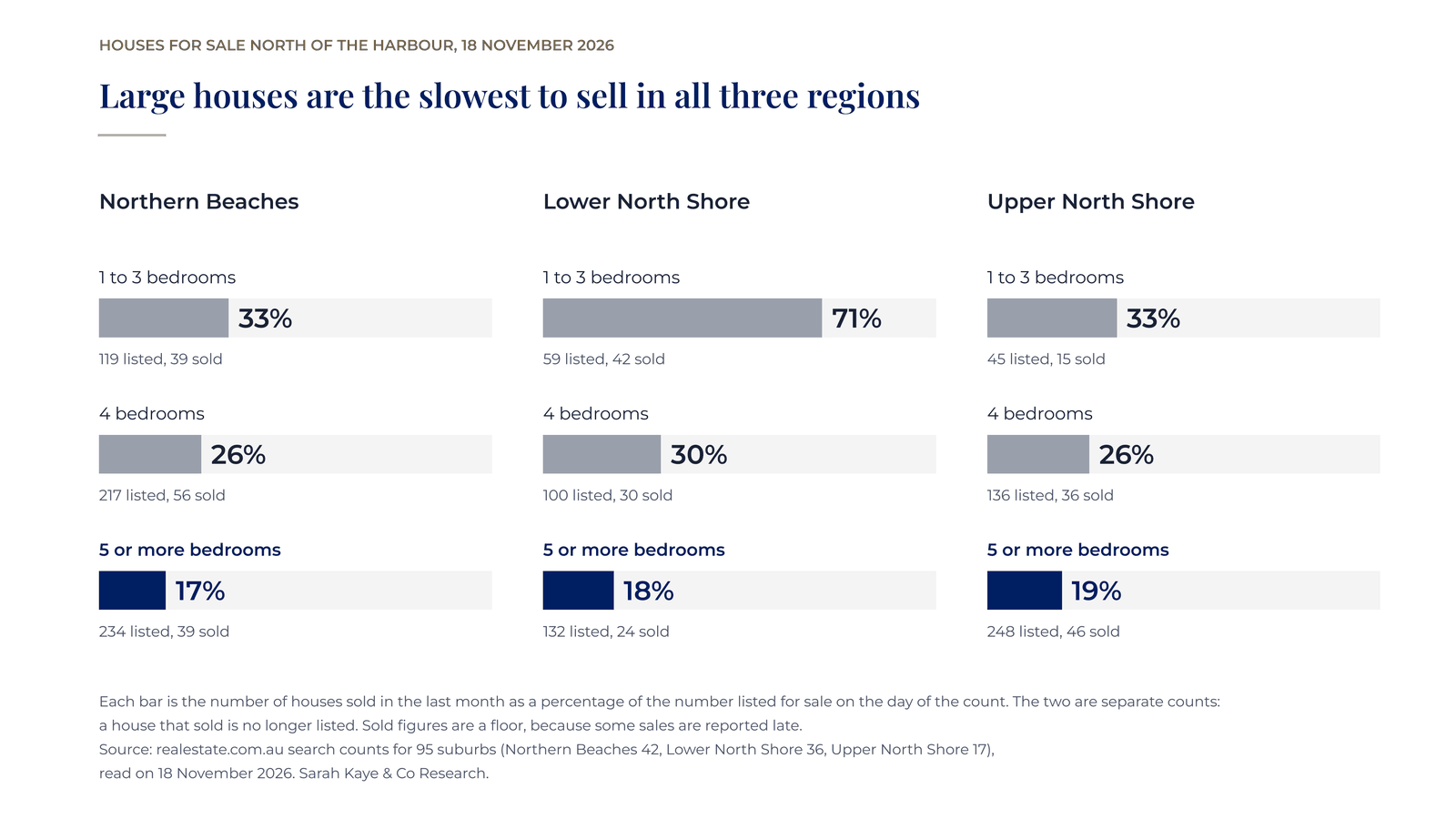
Where you look makes almost no difference. Large houses are the slowest house size on the Northern Beaches, on the Lower North Shore and on the Upper North Shore. The figure barely moves between them.
What it means for you. If you are buying a large family house, you have choice and you have time. Use both. Inspect widely. Compare each home against recent sales of the same size nearby. And do not let anyone hurry you. An owner whose home has been listed for a while may welcome an offer that comes with its evidence.
On the Northern Beaches, units are moving fastest
The Beaches is mostly a house market, but its units are where the pace is.
Two-bedroom units lead. There are 208 listed and 81 sold in the last month, which is 39%. On the Upper North Shore the same measure is 24%. Studios and one-bedroom units on the Beaches are moving at a similar pace to the two-bedders.
Houses on the Beaches follow the wider pattern. The smaller the house, the faster it is turning over.
What it means for you. Good units on the Beaches are not sitting. Do your homework before you inspect, not after. Have your finance approved. Know the recent sales in the building and the street. And have the strata report read early, so you can move when the right one appears.
On the Lower North Shore, small houses are scarce and apartments are plentiful
Only 59 houses with one to three bedrooms are listed across the whole Lower North Shore, and 42 sold in the last month. Leaving aside a handful of townhouses, that is the tightest category we counted. On the Northern Beaches and the Upper North Shore, about one small house sold for every three listed.
Apartments are the opposite. The Lower North Shore has 802 units for sale, more than the other two regions combined. That includes most of the new, off-the-plan listings north of the harbour.
So one region holds two different markets. A buyer after a small house is competing. A buyer after an apartment is choosing.
What it means for you. For a smaller house here, expect competition. Know your limit before the day, and be ready to walk away above it. For an apartment, take your time and be selective. With this much choice, the building matters as much as the unit. Read its strata records, ask about defects, and find out what is planned next door.
The Upper North Shore is turning over most slowly
Sales in the last month equal 20% of what is listed on the Upper North Shore. The other two regions sit at 27% and 28%.
Part of the reason is what is for sale there. More than half of its houses have five or more bedrooms, and that is the slowest stock in every region.
It is not only the big houses. Units are turning over more slowly here than in either other region. Townhouses stand out too, with 49 listed and 2 sold.
What it means for you. You have time to do the work here. Ask how long a home has been listed, and whether the price has moved, before you make an offer. Then let the comparable sales set your number, not the asking price.
What we will watch from here
One count is a photograph, not a trend. The next few will tell us which way this is moving. We will be watching three things:
- whether the number of large houses for sale rises or falls from 614
- whether small houses on the Lower North Shore stay this tight
- whether the Upper North Shore moves off 20%.
For now, the market north of the harbour is not short of homes. What it has most of is the kind that is selling slowest.
If you would like these numbers read against a home you are weighing up, that is the work we do as buyers agents for the Northern Beaches and North Shore. Book a Zoom Call.
Our auction count for the week to 14 November covers the same suburbs.
The numbers behind this
How we counted. We ran 75 fixed searches on realestate.com.au on 18 November 2026, across 95 suburbs: 42 on the Northern Beaches, 36 on the Lower North Shore and 17 on the Upper North Shore. Each search has surrounding suburbs switched off and no price filter.
What to keep in mind:
- These are counts of listings, not homes. A new development is one listing, however many apartments it holds.
- For sale includes homes under offer that the agent has not yet taken down.
- Sold figures are a floor. Agents report some sales late, and some never.
- The percentage compares two separate counts. A home that sold is no longer listed, so it is not a share of one group.
- Units means the site’s “Apartment and unit” type. Villas and land are not counted.
| Region | Listed for sale | Sold in the last month | Sales as a percentage of listings |
|---|---|---|---|
| Northern Beaches | 999 | 274 | 27% |
| Lower North Shore | 1,119 | 309 | 28% |
| Upper North Shore | 740 | 149 | 20% |
| North of the harbour | 2,858 | 732 | 26% |
| North of the harbour | Listed for sale | Sold in the last month | Sales as a percentage of listings |
|---|---|---|---|
| Houses, 1 to 3 bedrooms | 223 | 96 | 43% |
| Houses, 4 bedrooms | 453 | 122 | 27% |
| Houses, 5 or more bedrooms | 614 | 109 | 18% |
| All houses | 1,290 | 327 | 25% |
| All units | 1,459 | 381 | 26% |
| All townhouses | 109 | 24 | 22% |
Source: realestate.com.au search counts, 18 November 2026. Sarah Kaye & Co Research.
About the author
Mike Kaye is Co-Founder and Director of Sarah Kaye & Co., a director-led independent buyers’ agency for Sydney’s Northern Beaches, Upper North Shore, and Lower North Shore. A former Accenture Global Partner and Graduate of the Australian Institute of Company Directors (GAICD), with formal qualifications in property law, valuation, and economics, Mike advises clients on disciplined property acquisition, risk management, and long-term capital protection. He writes a monthly property column for the Sydney Observer; this note carries the data behind the November 2026 column, “The front-page suburb”.