
There’s no shortage of opinion about apartment defects in NSW — but surprisingly little of it is grounded in solid data. For anyone considering buying an apartment in Sydney, particularly on the Northern Beaches or the Upper North Shore, the most useful thing is to separate what’s actually known from what’s assumed.
Apartments remain one of the most accessible entry points into the Sydney property market. The vast majority of buildings perform as expected. Defects exist in every form of housing, including freestanding homes — apartments aren’t uniquely problematic. But the protections that apply, the data that’s available, and the questions buyers should ask are different from buying a house, and worth understanding before you sign.
What the data actually says
Two studies are routinely cited in discussions about apartment defects in NSW. They’re useful — but only if you read them carefully.
The 2023 NSW Strata Defects Survey, conducted by the Building Commission NSW with input from 642 strata buildings, found that 53% of buildings had serious defects in common property within six years of construction. Waterproofing was the most common issue at 42%. Fire safety systems came next at 24%. Only 34% of buildings with serious defects formally reported them to the regulator.
A 2012 UNSW City Futures Research Centre study surveyed 1,020 strata owners across NSW and found 72% reported at least one significant defect in their building. For buildings built since 2000, the figure rose to 85%.
These numbers are directional, not definitive. Both studies rely on self-reporting — by strata managers in one case, by owners in the other. Neither captures defects in older buildings, defects rectified quietly by owners corporations, or buildings that simply weren’t surveyed. There is no NSW-wide registry of apartment defects. Unless a defect is serious enough to trigger regulatory escalation, an NCAT dispute, or a legal claim, it generally doesn’t appear in any public dataset.
The most reliable takeaway from the data is the prevalence of waterproofing as the dominant defect category. That finding shows up consistently across every survey. For coastal areas like the Northern Beaches, where exposure to weather is meaningful, it’s the single most important thing to look for.

Understanding your protections
This is where most buyers get confused, and where the misinformation does the most damage. There are four distinct protection mechanisms in NSW, each with a different scope and different limits.
1. Statutory warranties (Home Building Act 1989)
Statutory warranties apply to all new residential building work in NSW, regardless of how many storeys the building has. They provide:
- 6 years for major defects — those affecting structural integrity, fire safety, waterproofing, or habitability
- 2 years for non-major defects — typically cosmetic or minor functional issues
- A 6-month extension to commence proceedings if a defect is discovered in the final 6 months of the warranty period
The warranty period starts from completion of the work, or from the date of the occupation certificate for strata buildings. Original and subsequent owners can both rely on these warranties. Enforcement is through Building Commission NSW’s complaint handling service, NCAT, or the courts.
2. Home Building Compensation Fund (HBCF)
The HBCF is a last-resort insurance scheme administered by icare. It applies to new homes and apartment buildings of three storeys or less, where the work is valued over $20,000.
It only pays out if the builder dies, disappears, becomes insolvent, or has their licence suspended for non-compliance with a tribunal order. Cover is capped at $340,000 combined for non-completion and defective work, and the claim windows mirror the statutory warranty periods — 6 years for major defects, 2 years for non-major defects, with a 6-month extension and an absolute outer limit of 10 years.
Apartment buildings of four storeys or more are not covered by HBCF.
3. Strata Building Bond and Inspections Scheme (SBBIS)
The SBBIS was introduced in 2018 to address the gap left by HBCF for taller apartment buildings. It applies to new residential strata buildings of four storeys or more, for contracts entered into from 1 January 2018.
Under the scheme, the developer must lodge a building bond equal to 2% of the contract price with Building Commission NSW before the occupation certificate is issued. (The rate increases to 3% from 1 July 2026.) An approved building inspector conducts interim and final defect inspections, and the bond can be drawn on to rectify any defects identified.
The scheme doesn’t apply to existing apartment buildings or those completed before 2018.
4. RAB Act enforcement powers
The Residential Apartment Buildings (Compliance and Enforcement Powers) Act 2020 — the RAB Act — gives Building Commission NSW direct regulatory powers over Class 2 (apartment), Class 3, and Class 9c buildings. These powers apply for up to 10 years after completion.
The Commissioner can issue Stop Work Orders, Prohibition Orders (preventing occupation certificates from being issued), and Building Work Rectification Orders compelling developers to fix serious defects. This is not a warranty or insurance. It’s a regulatory enforcement window that runs in parallel with the statutory warranty, and it can apply even after the 6-year warranty has expired.
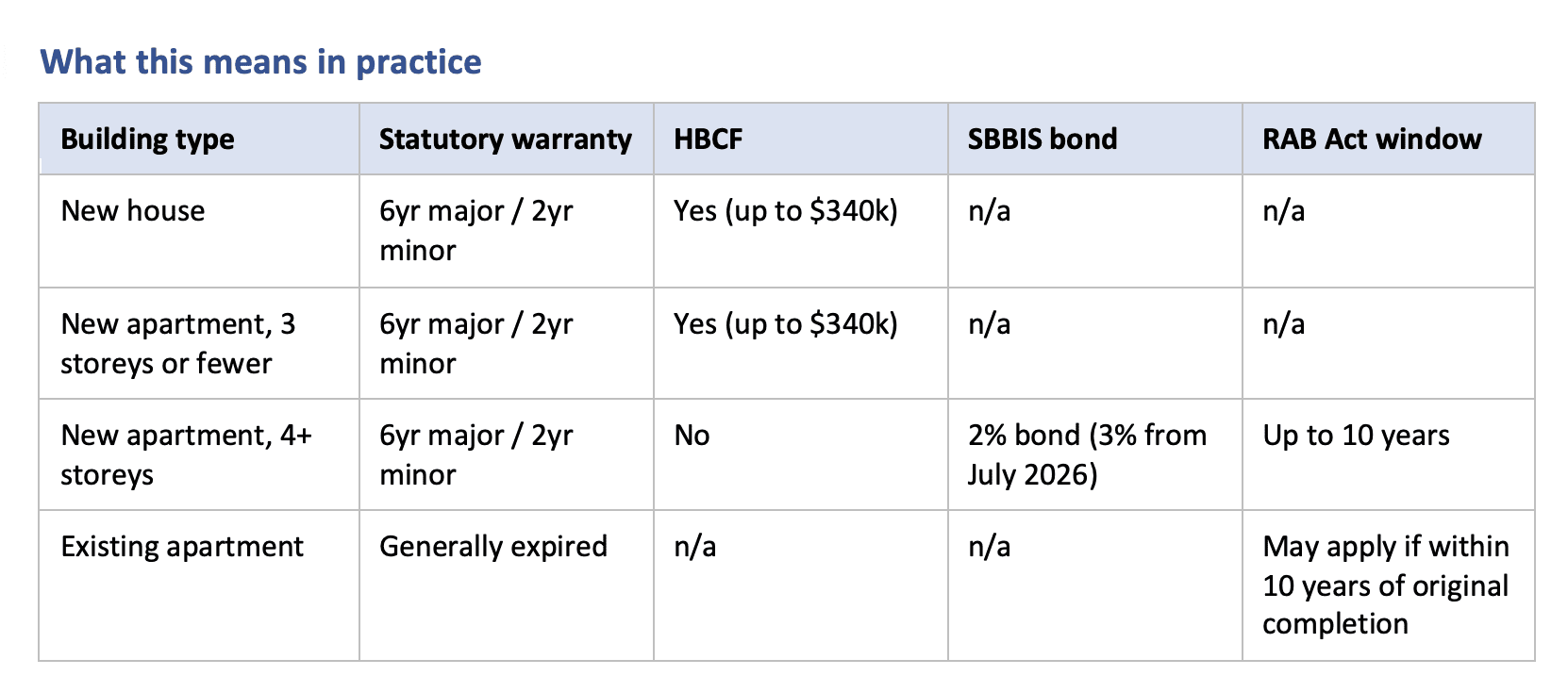
The protections available depend on the age, type, and height of the building. A new apartment in a four-storey building has the strongest combined protection regime. A twenty-year-old apartment has none of these — it relies on the owners corporation, the strata report, and the buyer’s own due diligence.
How defects actually get fixed
Most defect work happens quietly. NSW classifies works on strata properties into three categories: cosmetic work, minor works, and major works. The latter two typically require owners corporation approval, and most rectification falls into these categories.
Funding comes from the building’s capital works fund, from special levies raised by the owners corporation, or — where the building is within warranty — through claims against the builder. The 2023 survey found that 71% of buildings with serious defects resolved them by agreement with the builder. Less than half had rectification completed within a year.
These figures, again, only describe the visible subset. A building with a well-funded capital works account and a competent strata manager can quietly handle a major defect over twelve months without anyone outside the building knowing. That’s not failure. That’s a well-run building.
What buyers should actually look at
The data gaps matter less than they might seem, because the most useful information for a buyer isn’t in the survey data — it’s in the documents specific to the building you’re considering.
A strata report is the single most useful document a buyer can obtain. It reveals defect history, dispute records, special levy history, meeting minutes, and the financial health of the scheme. The sinking fund (capital works fund) balance is a strong signal — a healthy balance suggests proactive management. The special levy history can cut both ways: frequent levies may indicate underlying problems, or they may indicate a building that funds work properly rather than deferring it.
A 20-year-old building that has already rectified its waterproofing is, arguably, a lower-risk purchase than a 15-year-old building that hasn’t. Age alone tells you very little.
Other practical steps: commission an independent inspection of the lot and a strata inspection of the common property. Read the by-laws. Speak to the strata manager directly — they know more about the building than any report will tell you.
The honest framing
The defect data that exists is directional. It tells us that waterproofing is the most common issue, that defects in newer buildings remain widespread, and that most defect work is handled without ever becoming a public statistic. It doesn’t tell us the true prevalence of defects in the broader apartment stock, and it shouldn’t be read as if it does.
For a buyer, the data gap isn’t a reason to avoid apartments. It’s a reason to do the work before you buy — to understand which protections apply, to read the strata report carefully, and to choose a building that’s well-funded and well-managed. A well-chosen apartment in a well-run building is, for many buyers across Sydney’s Northern Beaches and Upper North Shore, the right call.
Sarah Kaye & Co is a Northern Beaches buyers agent helping clients navigate the Sydney apartment market with clarity and evidence. For tailored advice on a specific building or purchase, get in touch.