

Why the auction clearance rate isn’t measuring what you think
A buyer’s agent’s view on why the headline figure tells you almost nothing about Sydney’s Northern Beaches market — and why the methodology guarantees it stays that way.
If you’re trying to read the Sydney market in 2026, the weekend auction clearance rate is one of the least informative numbers in front of you.
Every Sunday morning, somewhere in the property pages, a number appears. This week the AFR ran with auction clearance rates “soaring” into the high 60s and low 70s. A few weeks earlier, the same outlets were reporting numbers in the 50s. The implication, every time, is that the rate is a thermometer — stick it in the market, read the temperature, get on with your day.
It isn’t a thermometer. It’s a marketing instrument dressed up as a market signal, and once you understand the maths, you stop being able to read these reports with a straight face.
As a buyer’s agent working across Sydney’s Northern Beaches, I rely on actual transaction data — sale prices, days on market, the gap between price guides and contract prices, what’s sitting unsold, what’s being quietly shopped off-market. The weekend headline — call it Sydney’s Northern Beaches auction clearance rate if you want a clearer label than the data providers give it — has no bearing on what I tell clients to bid. Here is why.
The maths is simpler than they make it look
Strip away the methodological variations between data providers and every clearance rate in this country reduces to roughly the same equation:
Sold ÷ (Sold + Passed in + Withdrawn)
Which means the only thing standing between any clearance rate and 100% — the only thing — is the count of passed-in and withdrawn properties in the denominator. If those two buckets shrink, the rate goes up. If they’re empty, the rate is 100% by definition.
The clearance rate isn’t really a measure of whether auctions sold. It’s a measure of how visible the failures were.
So the right question to ask isn’t “how many auctions cleared this weekend?”. The right question is: how easy is it to make passed-ins and withdrawals disappear from the data?
The answer is: very easy. And the system structurally rewards making them disappear.
First, what “passed in” and “withdrawn” actually mean
Passed in — an auction was held, the highest bid failed to meet the vendor’s reserve, the auctioneer declined to drop the hammer. The property did not sell at the auction.
Withdrawn — the vendor cancelled the scheduled auction before it took place. The property never went under the hammer.
Both should, in any honest market signal, count as failed auction outcomes. They’re the entire negative side of the ledger. If the metric can’t reliably count its own failures, it isn’t measuring anything.
There are no regulated definitions of either term. There is no independent body forcing agents to apply them consistently. The agent who has a direct commercial interest in the outcome looking favourable is the same person choosing which label to apply, and the data providers take their word for it.
Five ways a failed campaign disappears from the data
Here’s how a property that was never going to clear at auction can end up never registering as a passed-in or withdrawn in the dataset.
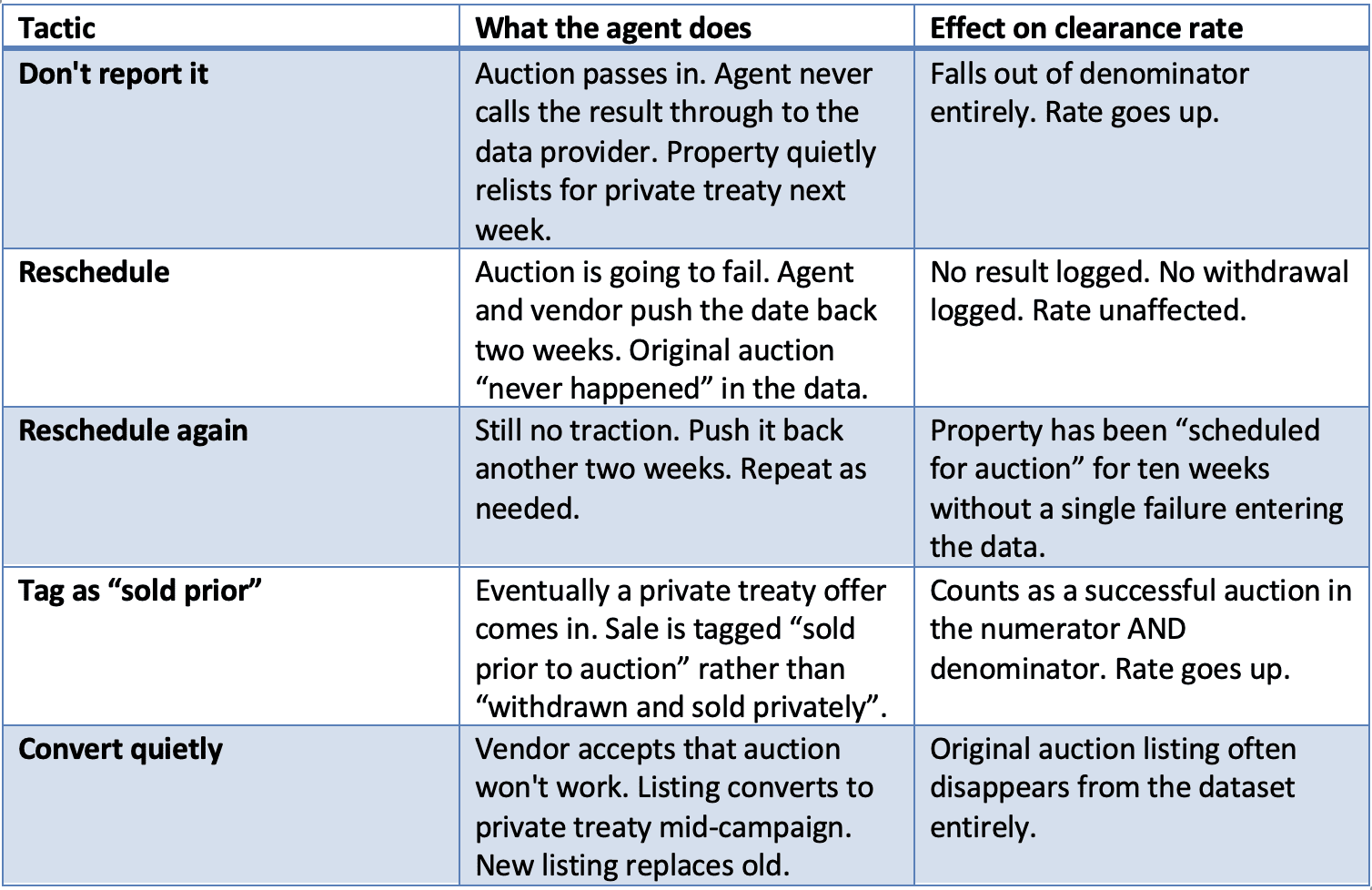
Stack these tactics together and you can run a campaign that fails on every meaningful measure — the property doesn’t generate competitive bidding, the auction never actually happens, the vendor accepts a private treaty offer well below the original price guide — and still have the outcome counted as a successful auction sale in the headline clearance rate.
A scenario you’d assume is impossible
Imagine 100 properties listed for auction across Sydney’s Northern Beaches on a given Saturday. The auction campaign runs four weeks. Two weeks in, every single one of those 100 properties sells via private treaty — direct negotiation, no auction held, no paddle raised, no auctioneer in sight. By the time Saturday rolls around, there is literally nothing to auction.
What clearance rate gets reported? 100%.
Not a typo. Under the methodology used by every major data provider — CoreLogic, Domain, SQM Research — a property listed for auction that sells before auction day is recorded as a “sold prior” and counted as a successful auction outcome. It goes in the numerator. It goes in the denominator. The fact that no auction occurred is methodologically irrelevant.
You can have a “100% auction clearance rate” in a week where exactly zero auctions actually took place.
This isn’t a hypothetical edge case. “Sold prior” is a legitimate, common, and rapidly growing share of the auction-tagged market. Industry analyses indicate “sold prior” running 20–30% of the scheduled auction count in some weeks. When agents sense a campaign is going to disappoint, the standard play is to take a pre-auction offer and tag it “sold prior”. Vendor saves face. Agent gets the commission. The data provider gets a clean tick in the success column. The market reads the headline and concludes demand is strong.
Why the system rewards disappearing failures
1. Reporting is voluntary, and not symmetrical
Real estate agents are not legally obliged to report auction results to data providers. The reporting is voluntary. CoreLogic’s own published methodology acknowledges that “real estate agents aren’t obliged to provide us with their results, however each week it is generally the same agents who choose not to provide their auction results to us.”
Read that twice. The same agents systematically don’t report. CoreLogic knows. They publish anyway.
The asymmetry is the giveaway: there is no equivalent bias in reporting successful auctions. Agents call those in immediately. The under-reporting bias is one-directional and structural — it always pushes the headline rate upward.
2. Preliminary numbers are calculated on missing data
When CoreLogic and Domain release their headline clearance rates on Saturday night, they divide reported sales by reported auctions — not by total scheduled auctions. CoreLogic itself captures roughly 60–75% of results by Saturday evening. The remaining 25–40% sit in an “unconfirmed” bucket and fall out of both numerator and denominator entirely.
Final clearance rates, published the following Thursday with more complete data, are routinely revised down 5–8 percentage points. That revision rarely makes the news cycle. The Sunday paper headline is the one that sticks.
3. The denominator can be reshaped retrospectively
A property tagged “withdrawn” on Sunday can quietly become “sold prior” by Thursday if a deal closes during the week. A property in the “unconfirmed” bucket can be silently dropped from the dataset when it relists as private treaty. The data isn’t fixed at the point of the auction. It evolves throughout the week, and the direction of evolution is overwhelmingly toward labels that flatter the rate.
4. The publishers aren’t neutral
Domain is part of Nine Entertainment, which also owns the Australian Financial Review. So when the AFR runs a headline about clearance rates “soaring”, it is reporting on data produced by a subsidiary of its own parent company about a market its parent company also profits from advertising into. CoreLogic’s data feeds into REA Group products, which operate the country’s largest real estate advertising platform.
This isn’t a conspiracy. It’s structural. When the metric flatters the people who produce, distribute, and consume it, the methodology drifts in predictable directions.

What an honest buyer should look at instead
I don’t pay much attention to the weekend clearance rate. Here’s what I do pay attention to:
- Volume of withdrawals as a percentage of scheduled auctions, where it’s captured. When this rises, vendors are losing confidence faster than buyers are.
- The gap between price guides and contract prices on completed sales. This tells you whether agents are still using bait pricing or whether the market has caught up.
- Days on market for properties that converted from auction to private treaty. A property that switched campaigns and then sat for sixty days is telling you something the clearance rate isn’t.
- The “sold prior” share of total reported auction sales. When this rises, it usually means agents have lost confidence in actual auction-day bidding.
- Number of registered bidders at auctions you actually attend. Hard to find published, easy to count yourself.
- Off-market and pre-market activity. In segments where auctions are increasingly performative, the real action moves quietly elsewhere.
- Final (Thursday) clearance rates from SQM Research, which uses the most defensible methodology — scheduled auctions in the denominator, withdrawals counted as failures, no “sold after” credit.
The point
I’m not arguing the auction clearance rate is fabricated in the sense of being made up out of thin air. The numbers are real. The methodology is documented. Anyone who wants to read the fine print can read the fine print.
I am arguing that the metric, as reported in the property pages each weekend, is a manufactured narrative. The maths reduces to a single question — how visible were the failures? — and every structural feature of the system is designed to make those failures less visible. Voluntary reporting. Asymmetric incentives. Retrospective relabelling. Rescheduling without a footprint. “Sold prior” as a get-out-of-jail-free card. Publishers who profit from auctions looking healthy.
A 100% auction clearance rate can be achieved in a week with zero auctions. A 70% clearance rate can mask a 50% reality. Both are features of the methodology, not bugs.
If you’re a buyer making a real decision in Sydney’s Northern Beaches market, ignore the weekend headline. Look at completed sales, look at withdrawals where you can find them, look at days on market, talk to someone who attends auctions in person and watches the registration table. The clearance rate is not your friend. It was never designed to be.
— — —
About the author
Mike Kaye is Co-Founder and Director of Sarah Kaye & Co., a boutique, director-led buyers agency working across Sydney’s Northern Suburbs — the Northern Beaches, the Lower North Shore, and the Upper North Shore. Mike leads Sarah Kaye & Co Research, the firm’s in-house analytics practice. A former Accenture Global Partner and Australian Army Officer, he studied property law, valuation, and economics at UNSW and is a Graduate of the Australian Institute of Company Directors. His articles have been profiled in the Australian Financial Review, the Sydney Morning Herald, and AICD Magazine. As a Northern Beaches buyers agent, Mike works exclusively for buyers — fixed-fee, no kickbacks, with over 75% of clients’ homes secured off-market.