Sarah Kaye & Co Research
Three different things get called underquoting in NSW, and only one of them is an agent breaking the rules. Here is how to tell them apart, and what to check before you pay for reports.
We are buyers agents. You would expect us to say underquoting is rife in NSW and that selling agents are to blame. We can’t say that honestly. In our own work we have come across some underquoting, but not a lot.
That claim needs a caveat, so here it is. We buy in three regions north of the harbour, and much of what we buy is off-market. We rely less on advertised guides than most buyers do.
Even so, we think the argument about underquoting in NSW has put three different things under one word. Only the first is an agent breaking the rules. Blaming agents for all three is easy. It is also wrong.
It matters now because the NSW Government has postponed its underquoting reforms to 1 December 2027, hours before they were due to start. That leaves a year to work out which problem the law is meant to fix.
An agent quoting below their own estimate is underquoting, and it happens
The law on this one is clear. A selling agent records an estimated selling price in the agency agreement. They cannot advertise or quote below it. That rule was not postponed. Underquoting is unlawful in NSW today.
It still gets broken. Before spring, NSW Fair Trading inspectors went to almost 80 open homes over two months. Ten agents were fined. In one case buyers were told a home would likely sell for $3.65 million, while the agency’s own records put it at $4 million to $4.4 million.
Ten fines from about 80 visits can be read two ways. Either the practice is uncommon, or the visits are too few to find it. We don’t know which. Nor does anyone quoting a confident number. The state’s own property commissioner says the overwhelming majority of agents do the right thing. That matches what we see.
What it means for you. This is the only one of the three that is an offence. If an agent quotes you one figure and you believe their agency agreement says a higher one, report it to NSW Fair Trading.
The vendor’s number sits outside the underquoting rules
This is the gap most buyers fall into, and it is not of the agent’s making.
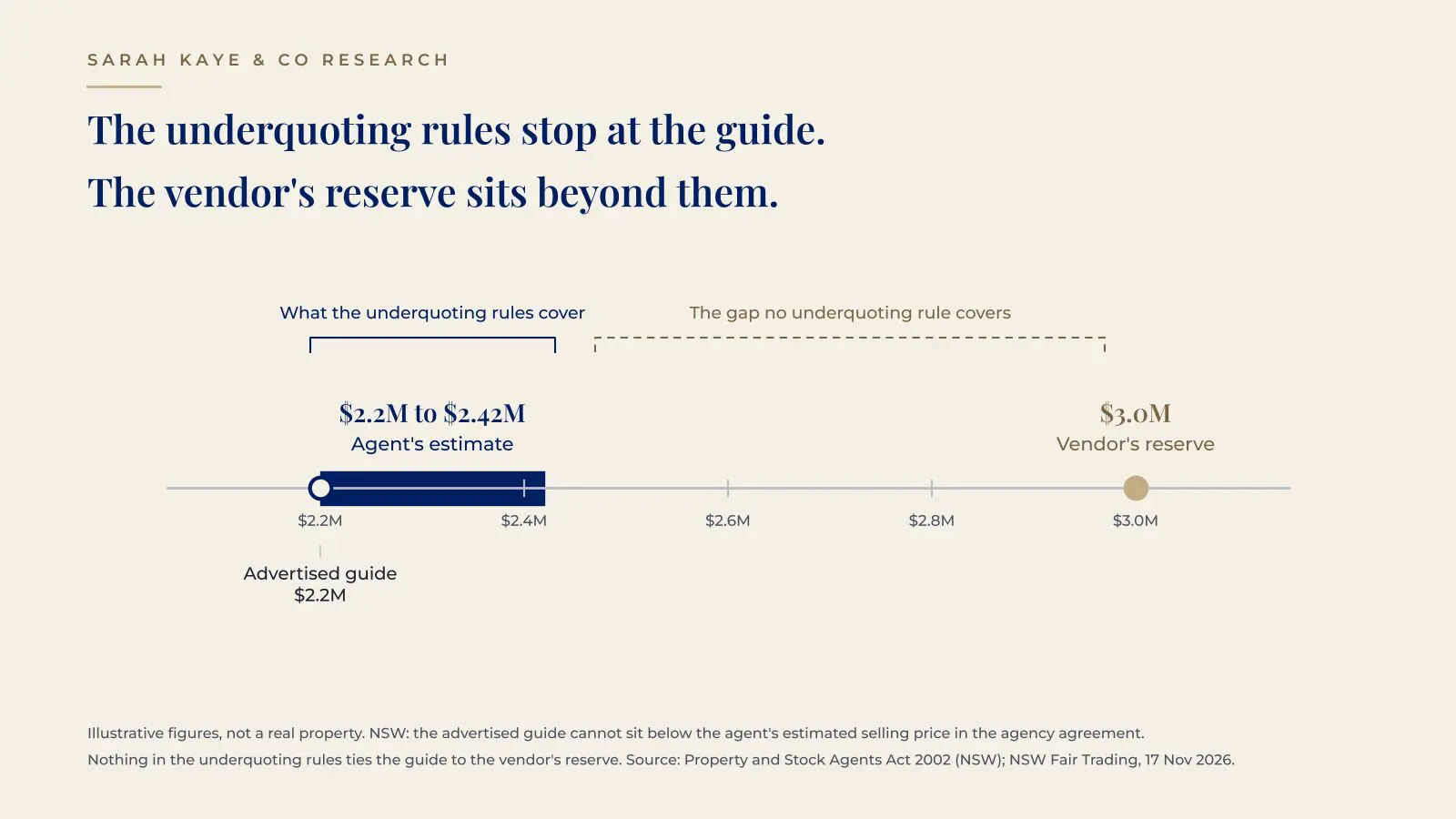
Every home for sale carries more than one price. The agent’s estimate is one. The advertised guide is another, and it cannot sit below the estimate. The reserve is a third, and it belongs to the vendor.
The NSW underquoting rules measure the guide against the agent’s estimate. They do not measure it against the reserve. An agent can hold an honest estimate of $2.2 million while the owner will not sell under $3 million. The guide does not breach the underquoting rules. The buyer who paid for a building report never had a chance.
Consumer law can still reach an agent who advertises a price they know the vendor has ruled out. That is a harder case to make, and it is rarely the one people mean.
Agents know this problem better than anyone. They are the ones telling an owner, sometimes for weeks, that the market has moved. It is the owner’s home and the owner’s decision.
The postponed rules tried to deal with it. A home could not be advertised below a written offer the vendor had refused. In a market that has fallen about 10% since February, that would have stopped owners from meeting the market. Industry leaders asked for a narrow fix. The government shelved the whole package.
What it means for you. Ask the agent what the guide is based on, and whether the vendor has refused any offers. A good agent will answer both. The answers tell you more than the guide does.
Competition lifts prices past honest guides
Some homes sell well above an accurate guide because two people wanted them.
A Newtown terrace sold recently for $1.825 million. Its guide was $1.65 million, which was also its reserve, the Australian Financial Review reported. Five of the six registered bidders put their hands up. That is $175,000 over the guide, in a market where fewer than half of Sydney’s auctions are clearing. Nobody was misled. The vendors set a guide they were prepared to sell at, and the bidders did the rest.
The opposite happens too. A Haberfield house was guided at $2.5 million to $2.75 million and sold for $2.56 million. The buyer almost stayed home. He assumed it would run past his budget. Many buyers do, after years of results above the guide.
That is the cost of using the word loosely. When every result above a guide is called underquoting, buyers stop believing honest guides. Then the vendor who priced fairly loses bidders.
What it means for you. A guide is the least the agent thinks a home is worth. It is not a forecast of the result. Work out your own price from recent comparable sales before you look at the guide.
The postponed NSW rules would not have closed the gap
NSW was adopting a model Victoria has run since 2017: a published guide, comparable sales, and a ban on advertising below a refused offer.
A report this month for the Australian Property Institute looked at 102,681 Victorian sales in the year to June. About 43% sold inside the first guide buyers saw. At auction it was one in three.
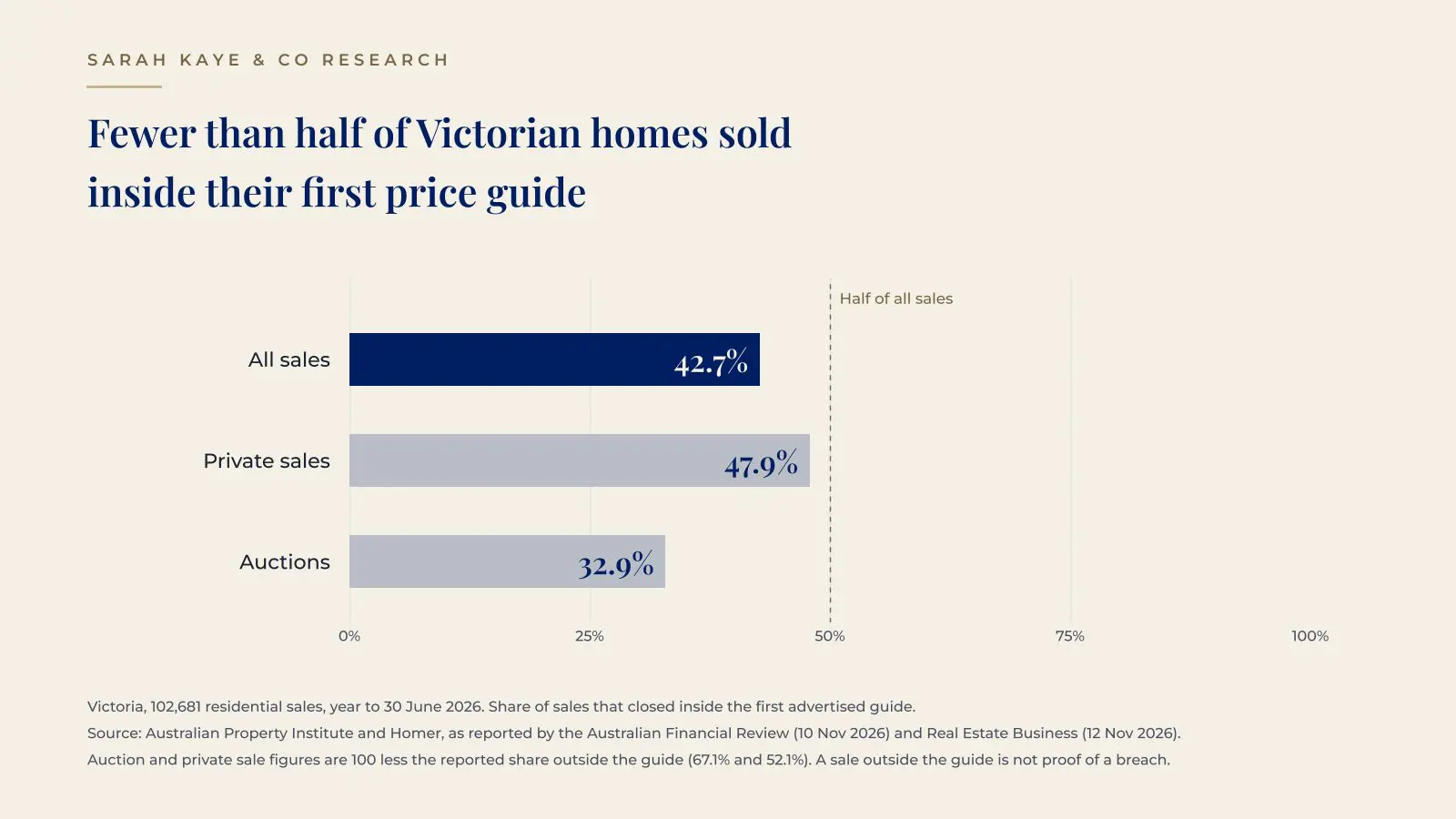
The misses ran both ways. Auction guides tended to sit low. Private sale guides tended to sit high. The report itself says a sale outside the guide does not prove anyone broke the law.
That is our point. Nine years of rules aimed at agents have not made guides predict prices, because the agent’s conduct is one cause of three.
None of this is an argument for dropping the reforms. A price on every advertisement and evidence behind every estimate are worth having. Buyers’ advocates are also right that underquoting in NSW will get more attention when rates fall and bidders come back.
The delay is a chance to write rules that work in a falling market as well as a rising one. They should deal with the vendor’s number as well as the agent’s.
What it means for you. Do not wait for the law. The guide tells you where the agent starts. Comparable sales tell you where the home sits. The vendor’s expectation decides whether it sells. Check all three before you pay for reports.
Date to watch. 1 December 2027, when the postponed NSW underquoting rules are now due to start. The government says it will consult consumer groups and the industry first.
For how auctions are tracking week by week across all three regions, see our auction results for the week to 14 November.
About the author
Mike Kaye is Co-Founder and Director of Sarah Kaye & Co., a director-led independent buyers’ agency for Sydney’s Northern Beaches, Upper North Shore, and Lower North Shore. A former Accenture Global Partner and Graduate of the Australian Institute of Company Directors (GAICD), with formal qualifications in property law, valuation, and economics, Mike advises clients on disciplined property acquisition, risk management, and long-term capital protection. He writes a monthly property column for the Sydney Observer; this note carries the data behind the November 2026 column, “The front-page suburb”.
Sources: NSW Fair Trading: Changes to property and stock agents laws; NSW Government: Open homes on notice in latest underquoting blitz; ABC News: Minns hits pause on laws targeting real estate underquoting; Real Estate Business: Victoria’s underquoting measures thrown into spotlight; Australian Financial Review, 10, 15, 16 and 17 November 2026.