

Executive Preamble: The Shift from Necessity to Strategy
The narrative surrounding property transition for the affluent demographic in Sydney has fundamentally fractured. For decades, the industry operated on a linear, almost fatalistic assumption: one accumulates assets, raises a family in a sprawling estate, and then, as age advances, “downsizes” into a retirement unit. This trajectory implied a contraction—not just of square footage, but of ambition, status, and lifestyle quality. It was a retreat.
In the current high-net-worth landscape of Sydney’s Northern Corridor—spanning the Northern Beaches, the Lower North Shore, and the Upper North Shore—this narrative is obsolete. We are witnessing the emergence of a sophisticated, capital-rich cohort that rejects the pejorative implications of “downsizing.” These are not individuals seeking to reduce their standard of living; they are engaging in “Strategic Right-Sizing.” This is a calculated, high-stakes reallocation of equity from maintenance-heavy legacy estates into high-performance, lifestyle-optimised assets.
Sarah Kaye & Co. identifies this shift as the defining property trend of the decade. Our clients are not driven by financial distress or the necessity to release cash for survival. They are driven by the desire for “luxury without friction.” They command significant equity, often owning mortgage-free homes in suburbs like Wahroonga, Mosman, or Manly, and are prepared to reinvest that capital into properties of equal or even greater value per square metre, provided the asset delivers superior liquidity, architectural integrity, and future-proofed accessibility.
This report serves as a definitive strategic instrument for this demographic. It dismantles the “retail” market perception and exposes the mechanics of the “Silent Market.” It validates the overlooked opportunities in the Upper North Shore and analyses the topographical scarcity of the Northern Beaches. It is written for the discerning buyer who requires the “Adults in the room” to navigate a complex, hyper-competitive landscape where the most valuable assets never appear on a public portal.
The Psychology of the Pivot: Why “Downsizing” is a Dirty Word
The Semantics of Status and Loss
The terminology used in real estate is rarely accidental, and the recoil among wealthy clientele toward the word “downsizing” is rooted in deep psychological triggers. To “downsize” is to reduce, to diminish, to lower. In the corporate world, downsizing is a euphemism for firing staff. In the automotive world, it means trading a V8 for a hatchback. For a demographic that has spent forty years ascending the ladder of success—building businesses, commanding boardrooms, and accumulating trophy assets—the concept of “downsizing” feels like an admission of defeat. It implies that one can no longer “handle” the main game.
At Sarah Kaye & Co., we have scrubbed this word from our lexicon when advising private clients. The reality of the transaction is rarely a “step down.” A client selling a $6 million federation estate in Turramurra to purchase a $5.5 million luxury sub-penthouse in Milsons Point is not downsizing in any financial sense. They are executing a Strategic Asset Reallocation. They are trading land value (which requires labour to maintain) for structural value (which offers services and security). They are swapping the liability of a pool and a tennis court for the asset of a concierge and a harbour view.
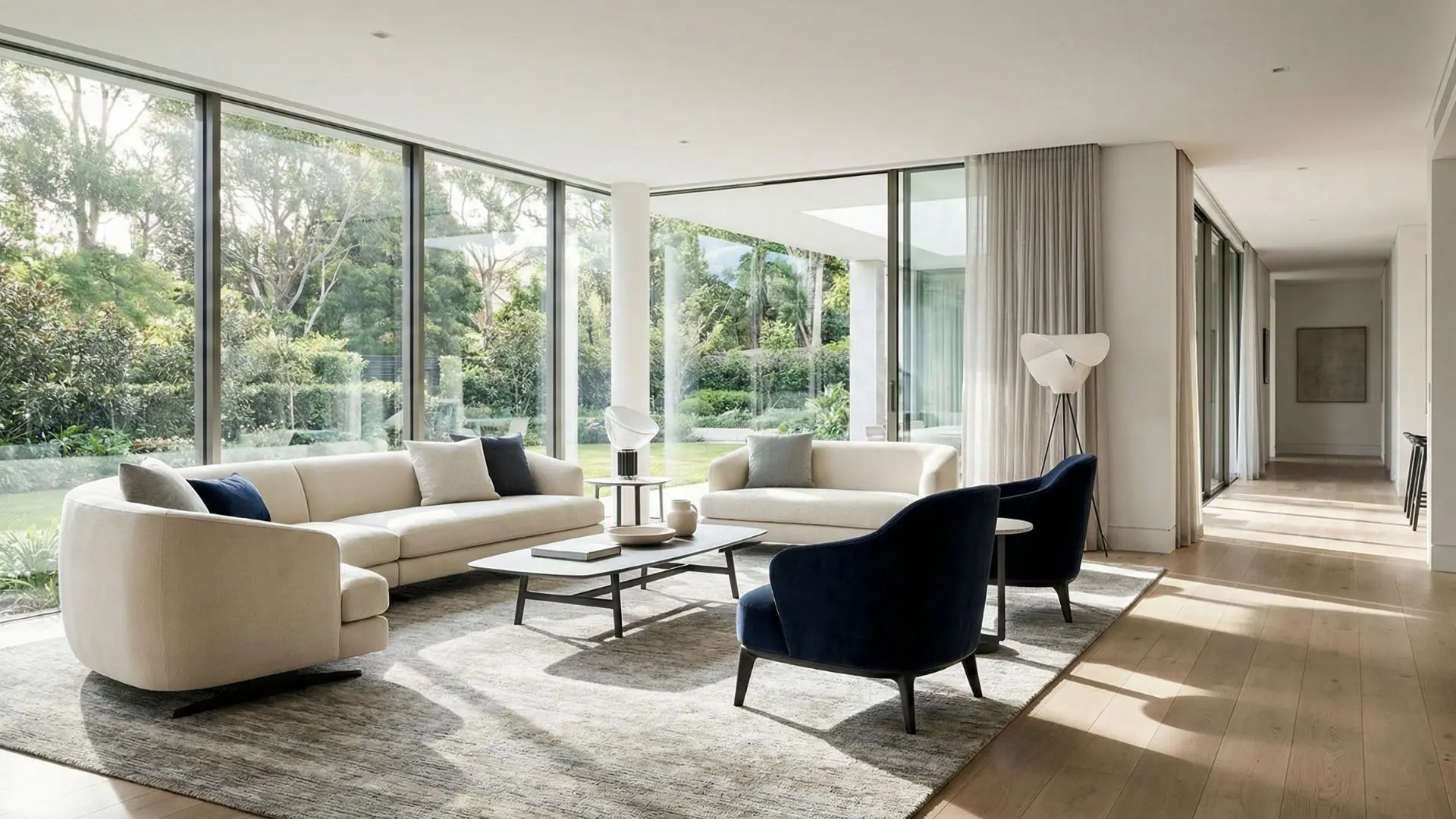
The friction is most acute when the industry attempts to sell “retirement” products to this group. The wealthy Baby Boomer and Gen X buyer does not identify as “elderly.” They are active, globally mobile, and culturally engaged. They do not want to live in an “over-55s” enclave that feels like a departure lounge for the inevitable. They want to live in dynamic, multi-generational precincts where they maintain their sovereignty and status. They demand “house-like proportions”—floor plans exceeding 200 square metres, multiple living areas, and high-spec kitchens—because they intend to continue entertaining and accommodating family.
The Financial Rationale: Liquidity and Superannuation
Beyond the psychological and physical drivers, there is a compelling financial architecture supporting the right-sizing trend. The Australian government has explicitly incentivised this behaviour through the “Downsizer Contribution” into superannuation. This legislation allows eligible individuals aged 55 and over to contribute up to $300,000 (or $600,000 per couple) from the proceeds of selling their primary residence into their superannuation fund.
For the high-net-worth client, the $300,000 cap may seem nominal relative to a $5 million asset sale, but the strategic value lies in the exemption mechanics.
- Cap Exemption: The contribution does not count towards the non-concessional contribution cap.
- Age Exemption: It can be made regardless of the work test.
- Balance Exemption: It is exempt from the $1.9 million Total Super Balance restriction (though it counts towards the Transfer Balance Cap once in the pension phase).
This creates a tax-effective vehicle for converting a non-income-producing asset (the family home) into an income-generating investment structure (superannuation pension phase). However, the real financial driver for the Sarah Kaye & Co. client is often Asset Reallocation. By right-sizing from a $6 million estate in Wahroonga to a $4 million luxury apartment in Turramurra, Mosman or Freshwater, the client releases $2 million in tax-free equity (assuming main residence exemption). This capital can be deployed into diversified income streams, helping children enter the property market, or purchasing a secondary lifestyle asset (e.g., a holiday home in Palm Beach or the Southern Highlands).
The “Right-Sizing” calculation is therefore a complex equation of:
Net Benefit = (Lifestyle Friction Removed) + (Capital Released) + (Future Accessibility Gained) – (Transaction Costs)
For wealthy clients, the “Transaction Costs” (Stamp Duty, Agent Fees) are high, which is why the move must be “Strategic.” A mistake—buying the wrong apartment, in the wrong building, with the wrong strata profile—can erode millions in equity and destroy the lifestyle dividend. This is why “Institutional Rigour” and “Forensic Due Diligence” are the cornerstones of the Sarah Kaye & Co. offering.

The Strategic Landscape: A Tripartite Ecosystem
To navigate the right-sizing opportunity, one must understand the distinct “micro-climates” of Sydney’s Northern Corridor. This is not a homogeneous market. The Lower North Shore, Upper North Shore, and Northern Beaches operate as distinct ecosystems with unique pricing structures, demographic profiles, and inventory constraints.
The Lower North Shore: The Urban-Coastal Hybrid
The Lower North Shore (Mosman, Cremorne, Neutral Bay, Kirribilli) represents the apex of high-density luxury. It is the natural habitat for the right-sizer who prioritises connectivity and cosmopolitan energy.
- The Asset Class: Here, right-sizing means moving into a “Super-Prime” apartment. These are residences that offer hotel-style amenities—concierges, gyms, infinity pools, and direct lift access.
- The Price Point: This is the most expensive sector. Median house prices hover consistently above $4–5 million, but the “Right-Size” product (a 3-bedroom harbour-view apartment) frequently trades in the $6 million to $15 million range.
- The Compromise: The trade-off is density. For a client coming from a private estate in Pymble, the noise, traffic, and proximity of neighbours in Neutral Bay can feel claustrophobic. The “quiet luxury” they are used to is replaced by “urban luxury”.
The Northern Beaches: The Insular Sovereign
The Northern Beaches (Manly to Palm Beach) functions as a lifestyle destination, distinct from the rest of Sydney. It is geographically bounded (the “Insular Peninsula”) and culturally distinct.
- The Asset Class: The demand here is for “Level Land” cottages, deep waterfronts, or boutique apartments in village hubs like Manly and Freshwater.
- The Price Point: Extremely varied. Manly rivals Mosman ($4m+ medians), while pockets of the upper peninsula offer relative value, albeit at the cost of accessibility.
- The Compromise: The “Peninsula Tax.” Commute times to the CBD can be 60–90 minutes from the upper beaches. For the retired right-sizer, this matters less, but access to major medical infrastructure (hospitals) can become a growing concern compared to the North Shore.
The Upper North Shore: The “Green” Validator
Often historically viewed as the “family belt”—a place to raise kids and then leave—the Upper North Shore (Wahroonga, Turramurra, St Ives, Pymble) has emerged as the strategic dark horse of the right-sizing market.
- The Asset Class: Boutique, low-rise developments set in garden estates.
- The Price Point: Offers a significant value arbitrage relative to the Lower North Shore.
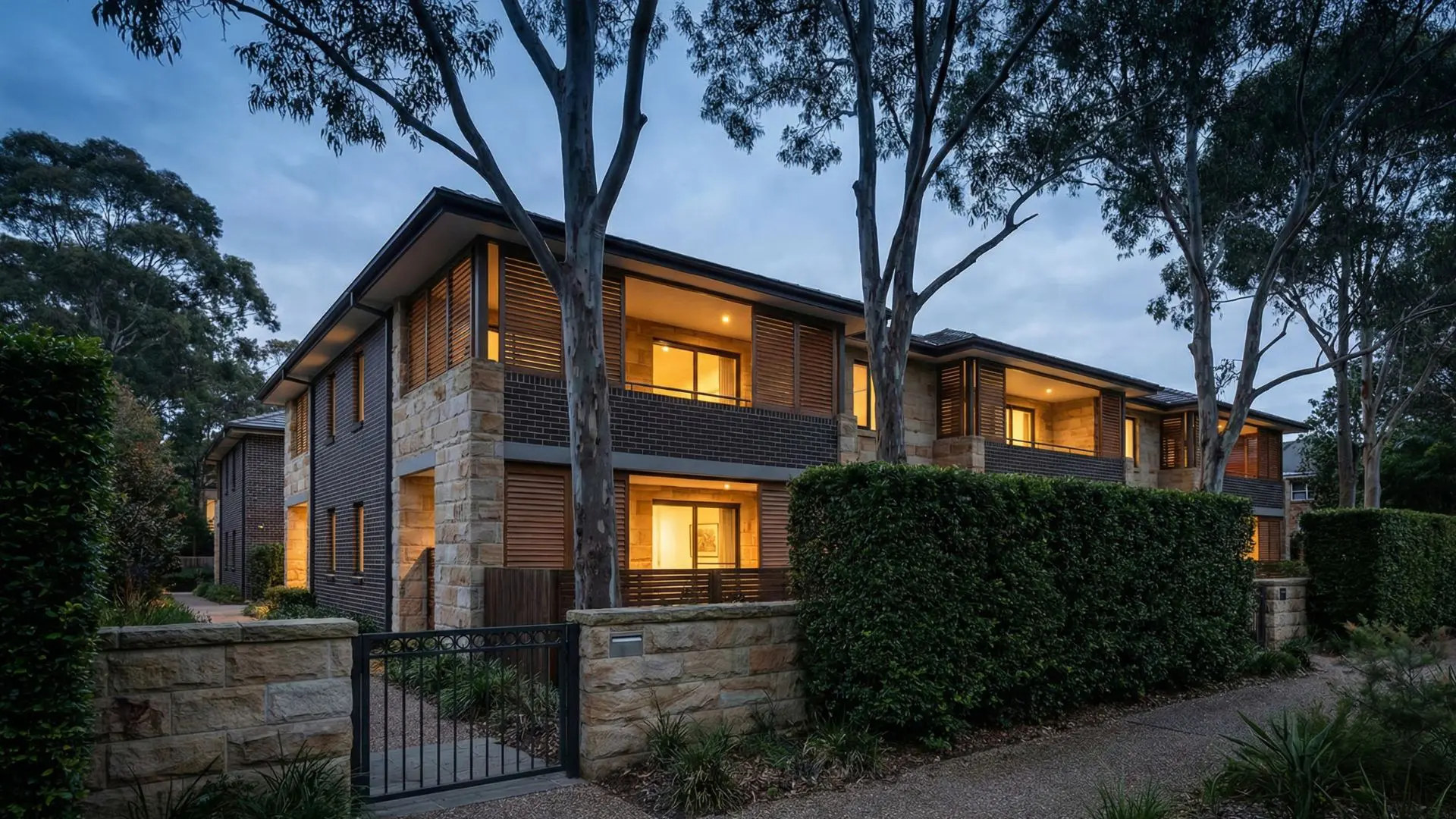
- The Opportunity: This region is the primary focus of our validation analysis, as it offers the unique combination of “Tree Change” tranquillity with world-class infrastructure, solving the “Missing Middle” problem for the affluent local demographic.
The following table synthesises the comparative metrics across these three regions, derived from our own market analysis:
| Strategic Metric | Lower North Shore | Northern Beaches | Upper North Shore |
| Primary Lifestyle Driver | Urban/Harbour Connectivity | Surf/Nature/Relaxation | Privacy/Community/Space |
| Dominant Right-Size Stock | High-Rise Luxury Units | Mixed (Cottages & Units) | Boutique Low-Rise/Garden |
| Commute Band (CBD) | < 30 Mins (Ferry/Train) | 45 – 90 Mins (Bus/Drive) | 30 – 45 Mins (Train/Metro) |
| “Level Land” Availability | Low (Hilly/Dense) | Critical Scarcity | Moderate (Suburban Plots) |
| Median House Price | $4.5M – $6.0M+ | $2.5M – $6.0M+ | $3.5M – $4.5M |
| Key Medical Access | RNS Hospital (High) | Northern Beaches Hospital | The San / Hornsby (High) |
| Silent Market Liquidity | High (Prestige Apts) | Very High (Legacy Estates) | High (Heritage/Local) |
Table 1: Comparative Strategic Matrix of Northern Corridor Right-Sizing Markets.
The Topography of Scarcity: Northern Beaches & The “Silent Market“
While the Upper North Shore and Lower North Shore offer a logic of “Product and Community,” the Northern Beaches offers the logic of “Lifestyle and Scarcity.” However, for the right-sizer, the Beaches presents a formidable geological adversary: Gravity.
The “Level Land” Asset Class
The Northern Beaches is defined by the Hawkesbury Sandstone plateau—spectacular escarpments, deep valleys, and soaring views. But topography often comes with a compromise in accessibility that becomes harder to justify over time.
For the 65+ demographic, stairs are the enemy. A view that requires a steep driveway, a funicular, or three flights of stairs is an asset with a built-in expiration date.
This creates a hyper-specific asset class: “Level Land”.
A block of land that is flat, on-grade, with street-to-door accessibility is the “Gold Standard” of the Beaches right-size market. These blocks are geologically rare. They exist primarily in the “Basins”—the sediment-filled valleys at the base of the hills.
- Collaroy Basin: The “Golden Mile” of level living. Walk to the beach, cinema, and B-Line.
- Manly Flat: The streets surrounding the lagoon and oval.
- Freshwater Basin: The streets nearest the sand (Undercliff, Charles).
- Newport Golden Triangle: The flat walk to the village.
Because these blocks are rare, they are contested not just by downsizers, but by young families (who want flat lawns for cricket) and developers. This “Dual Demand” creates extreme price resilience. In a downturn, steep blocks with views lose value; level blocks in basins hold firm. They are the “Blue Chip” of the coast.
The “Silent Market” Mechanics
It is in the pursuit of “Level Land” that the “Silent Market” becomes the primary battlefield. Sarah Kaye & Co. data indicates that over 75% of premium acquisitions in the Northern Beaches occur off-market. This is not a marginal statistic; it is the dominant market reality.
Why is the inventory silent?
- Privacy: The owners of these assets are often high-profile. In Palm Beach or Whale Beach, they are captains of industry or celebrities who shun the intrusion of open homes. They do not want their neighbours knowing their business.
- The “Unicorn” Status: Owners of rare level blocks know they hold a winning hand. They don’t need to advertise. They simply whisper to a local agent that they “might sell.” The agent then calls a buyer’s agent who they know has a qualified client. The deal is done in a boardroom, not on a billboard.
- Speed and Certainty: A silent deal can be executed in days. An auction campaign takes 4 weeks of stress, styling, and scrutiny. For an elderly vendor, the “Quiet Sale” is a lifestyle choice in itself.
The Tiers of the Silent Market
Navigating this requires understanding that not all “off-market” deals are created equal. We categorise them into three tiers:
- Tier 1: The Genuine Off-Market (The Gold Standard). Motivated sellers prioritising privacy or speed (divorce, deceased estate, distress). This is where strategic value is found.
- Tier 2: The “Unicorn” (The Trophy). Irreplaceable assets (e.g., deep waterfronts). The price is high, but the access is the value. You pay for the privilege of securing an asset that trades once every 50 years.
- Tier 3: The “Fake” Off-Market (The Trap). Listings blasted to thousands of emails to “test” a high price. Sarah Kaye & Co. filters these out, protecting clients from paying a premium for a non-exclusive opportunity.
Micro-Market Nuance: The Peninsula Strategy
Right-sizing on the Beaches is not a one-size-fits-all proposition. It requires a specific “Peninsula Strategy” tailored to the client’s tolerance for isolation.
- Manly: The “Cosmopolitan Option.” It offers the ferry commute and city vibe. Ideal for the “active” right-sizer who still consults in the CBD. Prices rival Mosman.
- Palm Beach/Avalon: The “Retreat Option.” Median age is 60. It is a “Blue Mind” lifestyle choice. The trade-off is distance. It is 60 – 90 minutes to the city. It is a true “sea change” within the metropolis.
- The “Invisible” Enclaves: Places like Hudson Parade (Clareville) offer deep-water frontage for boating enthusiasts. This is a niche but passionate sub-sector of the right-sizing market—buyers who are trading land for water.
The Financial & Legal Architecture: Structuring the Move
Strategic Right-Sizing is a complex financial manoeuvre that requires “Institutional Rigour” to execute safely. It is not just buying a house; it is restructuring a wealth portfolio.
Superannuation Integration
The “Downsizer Contribution” is a critical tool. As previously noted, the ability to inject $300k (individual) or $600k (couple) into super is a key liquidity event. However, the timing is critical. The contribution must be made within 90 days of settlement. The eligibility criteria (10-year ownership rule, main residence exemption) must be rigorously checked. Sarah Kaye & Co. coordinates with the client’s financial planners to ensuring the settlement period aligns with the liquidity requirements of the super fund.
Strata vs. Torrens: The “Control” Variable
A major friction point for wealthy right-sizers is the loss of control associated with Strata Title.
- The Risk: Buying into a building with a hostile body corporate, a sinking fund deficit, or looming special levies (e.g., cladding issues, waterproofing failures).
- The Sarah Kaye & Co. Filter: We apply a forensic lens to Strata Reports. We look for “red flags” in the minutes—disputes between owners, repetitive repairs, vague engineering reports. We treat the strata purchase with the same due diligence as a corporate merger.
- The “Company Title” Niche: In older, prestige buildings (especially in Kirribilli or Manly), “Company Title” is common. This requires specific legal expertise to navigate, as it involves buying shares in a company rather than title to land, and often comes with restrictive leasing or renovation bylaws.
Zoning and Development Risk
For clients buying “Level Land” or “Boutique” sites, Future Zoning is a critical variable.
- The Threat: Buying a quiet garden apartment in Turramurra, only to have the neighbouring block rezoned for a 6-storey boarding house.
- The Defence: We analyse the “Zoning Envelope” and the NSW Government’s “Transport Oriented Development” (TOD) maps. We predict where density is heading and steer clients towards “Heritage Conservation Areas” or established precincts where the risk of being built out is mitigated.

The Acquisition Methodology: “The Adults in the Room”
In a marketplace flooded with enthusiastic but inexperienced “buyer’s agents” who act as glorified couriers, Sarah Kaye & Co. offers a different proposition: Strategic Acquisition.
The “Insider-Outsider” Advantage
Our firm is built on a unique “Pincer Movement” of expertise.
- The Insider (Sarah): As a former leading sales agent, Sarah knows the “theatre” of the sale. She knows when an agent is bluffing about “other offers.” She knows how to read the silence on the phone. She has the “Legacy Network” of principals on speed dial.
- The Outsider (Mike): With a background as an ex-Army Officer and Global Consulting Partner, Mike brings “Boardroom Rigour.” He strips away the emotion. He values the asset based on yield, land value, and comparable data—not on the “vibe.” He ensures the price paid is defensible.
The “Zero Waste” Standard
We operate with a philosophy of “Zero Waste.” We do not waste time on properties that fail the forensic filter.
- The Filter: We immediately reject 40% of the homes we see. We reject them for damp, noise, poor floor plans, and strata risk. When we present a property, it is a curated, validated asset.
- The “Walk Away” Power: The ultimate leverage in any negotiation is the willingness to walk away. Because we rely on data, not emotion, we empower our clients to withdraw if the price exceeds the strategic value. This discipline protects our clients from the “Winner’s Curse” of overpaying in a frenzy.
Executing the “Silent” Deal
Negotiating a silent deal requires a different playbook to an auction.
- The Protocol: It is not about shouting the highest number. It is about solving the seller’s problem. Is it speed? Is it a lease-back? Is it privacy? By structuring the deal to meet the vendor’s invisible needs, we can often secure the property at a lower price than if it went to the open market.
- The Outcome: We convert the “Silent Market” from a theoretical concept into a tangible set of keys.
Conclusion: The Strategic Imperative
The decision to right-size is one of the most significant financial and lifestyle pivots a high-net-worth individual will make. It involves liquidating the family’s primary asset and selecting the platform for the next chapter of life.
The risks are real: buying a lemon, overpaying in a frenzy, or choosing a location that isolates rather than integrates.
But the opportunities are profound. The Upper North Shore offers a renaissance of boutique luxury. The Northern Beaches offers the unparalleled “Blue Mind” lifestyle for those who can navigate the scarcity of level land.
Executing this transition requires more than just a search engine. It requires strategy. It requires access. It requires the “Adults in the room.”
The Strategic Property Advisory.
| Region | Strategic Right-Sizing Summary | Key Opportunity |
| Upper North Shore | Validated “Tree Change” with new luxury stock. | The Gilroy / Hermitage: House-sized units for community retention. |
| Northern Beaches | High-scarcity “Lifestyle” play. | Level Land Basins: Collaroy/Manly/ other for future-proof accessibility. |
| Lower North Shore | High-density “Connectivity” play. | Super-Prime Units: Milsons Point/Mosman for maximum convenience. |