
Sarah Kaye & Co Research
On 1 October the Financial Review named Gordon, East Killara and North Curl Curl among the steepest price falls in the country. This is the data behind Mike’s November column in the Sydney Observer: what the register shows for each of the three suburbs, why a thin suburb median swings the way it does, and spring’s first reading against the test we set in winter.
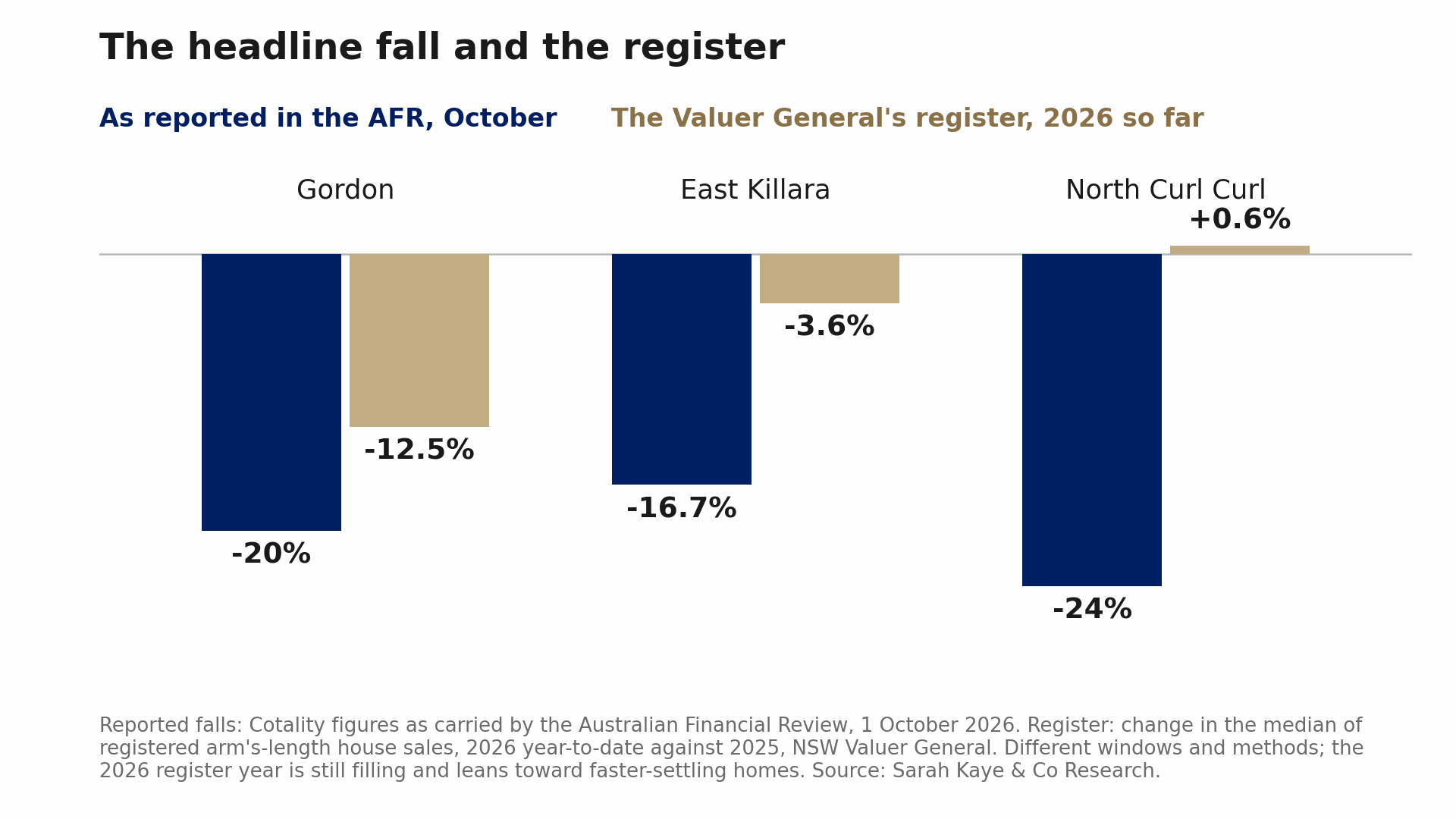
The reported falls were Cotality’s: Gordon house prices down 20 per cent, East Killara down 16.7 per cent, and North Curl Curl down 24 per cent, the steepest in the nation. Readers of the November column will know we did not argue with the papers. Sales volumes are weak, clearance is poor, and the NSW Valuer General’s register of settled sales confirms both. What the column could only sketch in print is set out here in full: the registered medians for all three suburbs, the resale pairs behind them, and the tables the magazine did not have room for.
What a thin median measures
A suburb median is the middle price of whatever happened to sell. In a large market that is a fair guide. In a suburb that trades forty houses a year, which forty sell moves the number more than prices do. One dear street quiet for a season, or three knock-down sites changing hands in a month, and the median jumps.
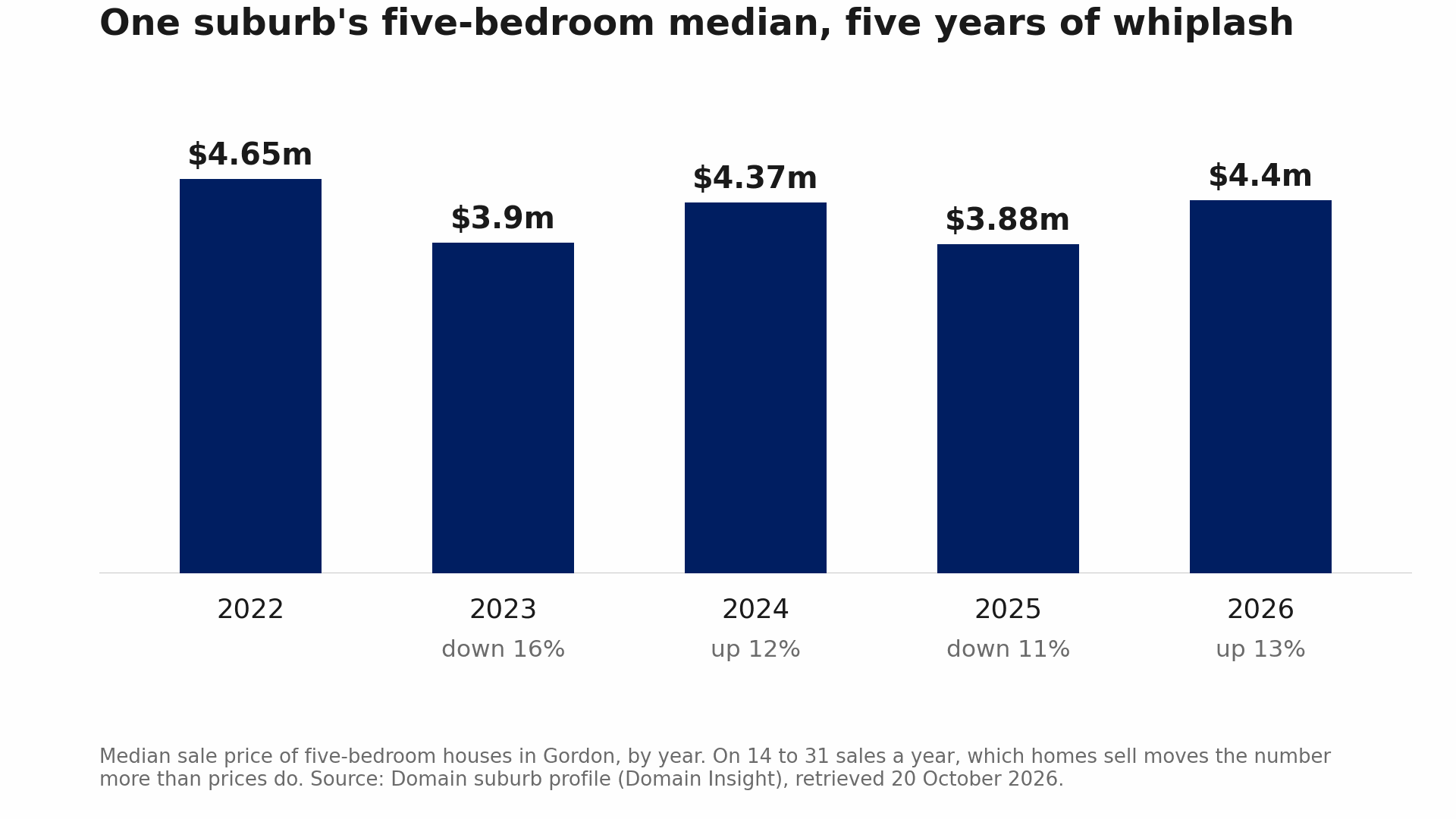
Gordon shows it in one chart. Domain’s median for a five-bedroom house in Gordon fell 16 per cent in 2023, rose 12 per cent in 2024, fell 11 per cent in 2025 and is up 13 per cent this year. No home in Gordon did any of that. The mix of homes sold did.
The three suburbs on the register
Cotality’s figures and the register measure different things over different windows, so the two columns below are not a contest. Cotality models the value of every home in the suburb each month. The register records what actually changed hands, and only once the sale has settled. Put side by side, they tell you how much of the headline is price and how much is mix.
| Suburb | Reported fall, 1 October | Register median, 2025 | Register median, 2026 so far | Change | 2026 sales |
|---|---|---|---|---|---|
| Gordon | down 20% | $3.80m | $3.325m | down 12.5% | 36 |
| East Killara | down 16.7% | $3.715m | $3.58m | down 3.6% | 17 |
| North Curl Curl | down 24% | $3.88m | $3.905m | up 0.6% | 24 |
Register medians are registered arm’s-length house sales by contract year, NSW Valuer General, as at the 19 October 2026 release. North Curl Curl’s 2024 median was $3.795 million, so three years of its register sit within three per cent of each other.
Gordon is the one of the three that is genuinely softer, and the resales say where. Of the seven Gordon apartments sold this year that had also sold within the previous five years, six went for less than their owners paid, typically 6 per cent less. The fall is real. Its size depends on the ruler.
One caveat, and it runs in one direction. This year’s register is still filling. Dear homes settle slowest, so the 2026 medians above will drift up as the year completes, not down. The register is a rear-view mirror with a slow shutter: a sale appears only once it has settled and been lodged, usually six weeks or more after the handshake.
We can make a scary number too
If the aim were a headline, the register could supply one. Of this spring’s sales already settled across our ten Upper North Shore suburbs, eleven of the thirteen houses were under $2.5 million, so the early house median is $1.95 million. Against last spring’s $3.385 million that is down 42 per cent. The same early reading in 2024 was also exactly $1.95 million, in a spring that finished perfectly well. Cheap homes settle fast and dear homes slowly, so an early median measures settlement speed, not value. We will quote spring’s medians when spring has settled.
Spring against the bar
In the October column we set spring’s test before the season could influence it. Winter’s resellers, people selling a home they had bought between eighteen months and five years earlier, typically made 2.5 per cent on what they paid, and a third took a loss. Beat that and the season worked. With the register now closed to 15 October, the winter reading has been re-run on the fuller data and holds.
| Resale pairs, ten suburbs | Pairs | Typical gain | Sold at a loss |
|---|---|---|---|
| Winter 2026, all homes | 56 | +2.4% | 34% |
| Winter 2026, houses | 22 | +2.5% | 36% |
| Winter 2026, units | 34 | +2.3% | 32% |
| Spring 2026, first reading | 4 | +6.1% | 1 of 4 |
Contracts 1 June to 31 August (winter) and 1 September to 9 October (spring), settled by 15 October 2026. Three of the four spring pairs are apartments, the quick settlers. Four pairs is directional only.
Four clean pairs is as thin as evidence gets, and we treat it that way. But it leans the right way: a typical gain of about 6 per cent, one of the four at a loss, and mostly apartments. December gives the verdict, when the season’s settlements have reached the register in volume.
Volume is spring’s weak point. On identical windows, 31 early-settled sales this spring against 61 last year and 32 in 2024. Half last spring’s pace. The advertised market is also only part of the market: across Sydney’s north at least one sale in eight happens off-market, in parts closer to one in four. That is one reason we weight the register over the auction clearance rate.
The five-bedroom tell
October’s open question was whether the school-year clock would bring family buyers back to the big houses. We promised the five-bedroom tell either way, and the season has six weeks to run, so this is half-time. Across nine of our ten suburbs, five-bedroom clearance averages 44 per cent over the trailing twelve months, exactly where it stood when we set the question in September.
| Suburb | Five-bedroom clearance, trailing 12 months |
|---|---|
| Roseville | 59% |
| Lindfield | 48% |
| St Ives | 48% |
| Wahroonga | 46% |
| Pymble | 45% |
| Turramurra | 45% |
| Gordon | 39% |
| Killara | 36% |
| Hornsby | 30% |
| Average, nine suburbs | 44% |
Domain suburb profiles (Domain Insight), five-bedroom houses, trailing twelve months, retrieved 20 October 2026. Warrawee’s profile was not available.
Killara and Gordon have edged up from about a third in September to 36 and 39 per cent. Roseville is the outlier at 59. No rush of family buyers yet. No collapse either.
The front doors agree, and this is a field note rather than a statistic. We spend most Saturdays at open homes across these suburbs. Under $2 million there are noticeably more buyers at the first opens of fresh, well-kept homes, most of them apartments. Between $2 million and $5 million it is patchy, but the genuinely good homes still draw a crowd in their first fortnight. Above $5 million it is quiet: some suburbs have little to buy, others have the stock but not the takers.
Between the forecasts
HSBC says the downturn is not even halfway done and expects a fall of 13 per cent in all. The Housing Industry Association’s economist expects prices to stabilise late this year and buyers to return early in 2027. Stockland reports its downsizer customers delaying because they cannot sell the family home, which is the squeeze we described in September, seen from the seller’s side. The register cannot settle that argument yet. But the early evidence sits closer to stabilising than to halfway: resellers back to modest gains, buyers returning at the entry end first, and a cash rate at 4.60 per cent with November’s meeting falling mid-season.
If you are buying in one of these suburbs
A front-page fall is not a discount you can bank. In Gordon the softness is real and shows up most clearly in apartments; in East Killara it is modest; in North Curl Curl the register has not moved. What a buyer can use is the method rather than the headline: the registered sales on the street you are looking at, the same-home resales that show what the last owner actually made, and a clear walk-away price set before the auction, not during it. That is how we work across the Upper North Shore and on the Northern Beaches, and it is the reading we bring to every first conversation.
Watch two things this month: whether the crowds at the entry-level opens turn into exchanges, and the full spring resale read, which we will put against winter’s bar in December, either way. The front page told you what happened to three medians. The register tells you what happened to the homes.
This note sits alongside Mike’s monthly column in the Sydney Observer, collected on our About page, and follows the Upper North Shore spring 2026 report, which set winter’s bar, and the winter register readout.
About the author
Mike Kaye is Co-Founder and Director of Sarah Kaye & Co., a director-led independent buyers’ agency for Sydney’s Northern Beaches, Upper North Shore, and Lower North Shore. A former Accenture Global Partner and Graduate of the Australian Institute of Company Directors (GAICD), with formal qualifications in property law, valuation, and economics, Mike advises clients on disciplined property acquisition, risk management, and long-term capital protection. He writes a monthly property column for the Sydney Observer; this note carries the data behind the November 2026 column, “The front-page suburb”.
Methodology and sources
Settled sales and resales: Sarah Kaye & Co Research analysis of NSW Valuer General Property Sales Information (Land Registry Services); ten core Upper North Shore suburbs (Roseville, Lindfield, Killara, Gordon, Pymble, Turramurra, Warrawee, Wahroonga, St Ives and Hornsby), as at the 19 October 2026 weekly release; East Killara and North Curl Curl are read from the same register. Arm’s-length sales only (no low-value, bulk or non-standard transfers), $400,000 and above. The register runs behind the market: a sale appears only once settled and registered, so recent months are incomplete and lean toward faster-settling, typically cheaper homes. Suburb medians are registered arm’s-length house sales by contract year; 2026 is a year in progress. Resale pairs match the same property across two sales (houses by the register’s property identifier; units by that identifier and the unit’s address, because every unit in a strata building shares one identifier); holds under 18 months (possible flips), gains above 60 per cent (likely rebuilds) and non-round prices (possible related-party transfers) are excluded, as is one fractional-interest transfer in Wahroonga. The winter 2026 reading rests on 56 pairs (22 houses, 34 units); the spring reading rests on four pairs and is directional only. Spring sales counts are lag-matched: contracts dated 1 September to 9 October, settled by 15 October, of each year. Five-bedroom clearance: Domain suburb profiles (Domain Insight), trailing twelve months, retrieved 20 October 2026; Warrawee’s profile was not available. Off-market shares: Sarah Kaye & Co Research analysis of 76 suburb reports, October 2026. Reported suburb falls, forecasts and company reporting: Australian Financial Review, 1 to 19 October 2026, carrying Cotality’s figures and HSBC and HIA comments, and Stockland’s September-quarter update as reported. Field observations are the firm’s own and are not statistics.